
In 2026, the boundary between our physical selves and our digital shadows has all but vanished. As we navigate the complexities of AI-mediated lives, The New Existentialism has emerged not just as a philosophical trend, but as a survival mechanism. While 20th-century thinkers grappled with the “death of God,” the modern seeker faces the “dissolution of reality” within the simulation and the crushing weight of digital solitude. This guide is your map through the void.
Quick-Start Roadmap (TL;DR)
- The Entry Point: The New Existentialism by Colin Wilson.
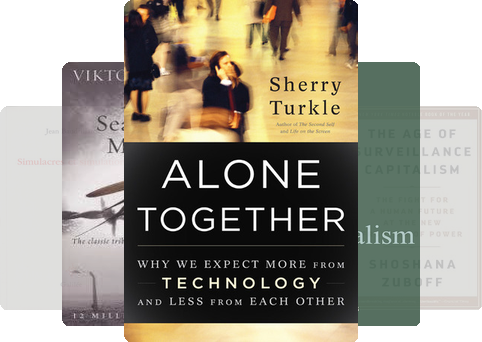
- The Modern Context: Alone Together by Sherry Turkle.
- The Deep Dive: The Age of Surveillance Capitalism by Shoshana Zuboff.
- Estimated Reading Time: 4-6 weeks for the full core curriculum.
The Entry Point: Why You Must Start with Colin Wilson
If you want to understand the shift from “passive” to “active” meaning, The New Existentialism by Colin Wilson is the cornerstone. Unlike the gloom of Sartre, Wilson argues that meaning is a “muscle” we can flex. In an age where algorithms decide our moods, Wilson’s focus on the “peak experience” provides a technical framework for reclaiming consciousness from the digital fog.
The Progression Path: Building Your Existential Armor
1. The Essentials (Foundation building)
Before tackling the simulation, you must understand the self. Start with Man’s Search for Meaning by Viktor Frankl to ground yourself in the necessity of purpose.
2. The Digital Shift (Contextualizing Solitude)
Read Alone Together by Sherry Turkle. It perfectly captures why we expect more from technology and less from each other—the literal definition of “Digital Solitude.”
3. Deep Dives (The Simulation & Systems)
Explore Simulacra and Simulation by Jean Baudrillard. This is the “red pill” of philosophy, essential for understanding how digital symbols have replaced physical reality.
4. The Masterpiece (The 2026 Perspective)
Finish with The Age of Surveillance Capitalism. Shoshana Zuboff explains how our inner lives are being “mined,” making the quest for an authentic self a radical act of rebellion.
Comparative Analysis Table
| Book Title | Difficulty Level | Main Theme | Reading Time | Why It’s Included |
|---|---|---|---|---|
| The New Existentialism | Moderate | Intentional Consciousness | 8 Hours | Provides the theoretical pivot from 20th-century pessimism. |
| Alone Together | Easy | Digital Alienation | 10 Hours | The definitive study on how tech creates “solitude.” |
| Simulacra and Simulation | Advanced | Hyperreality | 12 Hours | The philosophical basis for simulation theory. |
| Man’s Search for Meaning | Easy | Logotherapy & Purpose | 5 Hours | The ultimate proof that meaning is a choice. |
| Surveillance Capitalism | Advanced | Digital Autonomy | 20 Hours | Maps the forces trying to automate human behavior. |
Topic Deep-Dive: Navigating the Simulation
Modern existentialism in 2026 is no longer about sitting in Parisian cafes; it’s about the phenomenology of the interface. When we speak of “The Simulation,” we aren’t just talking about Matrix-style physics, but the social simulation—the curated personas and algorithmic feedback loops that make us feel like NPCs in our own lives. LSI Keywords: Technological alienation, hyperreality, digital authenticity, phenomenological method, cyber-solitude.
Vibe Map
Cerebral, Rebellious, Melancholic yet Empowering.
Frequently Asked Questions
A: It is the shift from seeing the world as “absurd and meaningless” (Old Existentialism) to seeing meaning as a latent human capacity that we must actively trigger through intensified perception.
A: Partly. It’s about the philosophical reality behind why we feel like we are living in a simulation, focusing on books that explain digital detachment.
A: No. We have curated this list to start with accessible authors like Frankl and Turkle before moving to technical giants like Baudrillard.
A: Paradoxically, books like Surveillance Capitalism suggest that total reliance on AI for meaning actually erodes your existential autonomy.
A: Solitude is the state of being alone; “Digital Solitude” is the state of being connected to everyone yet feeling seen by no one, often trapped in a simulation of sociality.
Resource Bibliography
For the best experience, seek out the 2026 Anniversary Edition of Colin Wilson’s works. For Baudrillard, the University of Michigan Press translation by Sheila Faria Glaser remains the gold standard for clarity.
Where to Buy: The Entry Point
Ready to start? Get The New Existentialism by Colin Wilson at these retailers: