
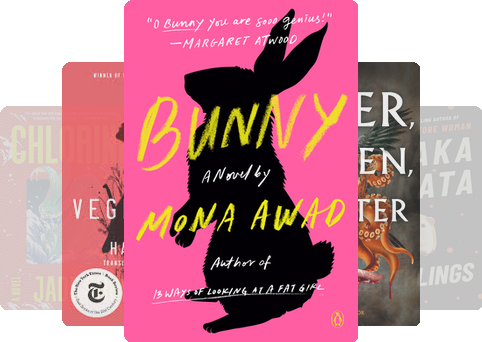
In the cultural landscape of 2026, the fascination with the “monstrous feminine” has shifted from the fringes of internet subcultures into a dominant literary force. Weird Girl Horror and its visceral sibling, Femgore, represent more than just a trend; they are a profound reclamation of the female body through the lens of the abject, the surreal, and the grotesque. This movement rejects the “sanitized heroine” in favor of protagonists who are messy, feral, and biologically transgressive. Whether it’s the psychological disintegration in a cult-like social circle or the literal transformation into something non-human, these stories provide a cathartic map of feminine rage and alienation.
The Entry Point: The Accessible Uncanny of ‘Bunny’
The absolute best place to begin is Bunny by Mona Awad. Why? Because it anchors the “weird girl” archetype in a recognizable reality—the competitive, suffocating world of MFA programs and female friendships. It serves as a bridge between dark academia and true surrealist horror. Awad utilizes a “sugar-coated” aesthetic to mask a decaying interior, making it the perfect introduction for readers who are accustomed to contemporary fiction but curious about the “weird.” It sets the stage for the themes of identity-loss and ritualistic behavior that define the genre.
The Progression Path: Categorized Recommendations
1. The Gateway: Bunny by Mona Awad
Focuses on the hive-mind of female cliques and the literal “creation” of the ideal man through dark magic and psychological breakdown.
2. The Transgressive Masterpiece: Earthlings by Sayaka Murata
If Bunny is the invitation, Earthlings is the point of no return. Sayaka Murata explores the life of Natsuki, who believes she is an alien to survive the trauma of her childhood. This book is essential because it pushes the boundaries of “weird” into the territory of the truly taboo, challenging the reader’s social conditioning regarding family, survival, and the human body.
3. The Poetic Abject: The Vegetarian by Han Kang
This Nobel-prize-winning novel acts as the intellectual backbone of Femgore. It chronicles a woman’s decision to stop eating meat, which evolves into a desire to become a plant. It is a quiet, devastating form of body horror that explores the violence of “normality.”
4. The Mythic Metamorphosis: Chlorine by Jade Song
Chlorine is a vital modern addition that bridges the gap between coming-of-age and body horror. It follows a competitive swimmer who is so desperate to escape the limitations of her human form that she begins a violent, gore-filled transformation into a mermaid. It is a raw, unapologetic look at the cost of “greatness” and the desire for a body that finally feels like home, even if that home is monstrous.
5. The Corporate Nightmare: Natural Beauty by Ling Ling Huang
This work rounds out the evolution by applying Femgore to the beauty industry. It examines how the quest for “perfection” leads to the literal consumption of the self, utilizing high-tech body horror to critique modern capitalism.
Comparative Analysis Table
| Book Title | Difficulty Level | Main Theme | Reading Time | Why it’s included |
|---|---|---|---|---|
| Bunny | Moderate | Social Hive-Mind | 7-9 Hours | Defines the “Weird Girl” social aesthetic. |
| Earthlings | Extreme | Alienation/Taboo | 5-6 Hours | The peak of transgressive “outsider” horror. |
| The Vegetarian | Advanced | Bodily Autonomy | 4-5 Hours | High literary merit; philosophical depth. |
| Chlorine | Moderate | Obsession/Mutation | 6-7 Hours | The best example of mythic-themed Femgore. |
| Natural Beauty | Moderate | Commodification | 7-8 Hours | Critiques the modern beauty-industrial complex. |
Topic Deep-Dive: The Bio-Politics of Femgore
The term Femgore—a portmanteau of “Feminine” and “Gore”—describes a specific aesthetic and narrative preoccupation with the visceral reality of the female body. Historically, horror has treated the female body as a site of victimization (the “Final Girl”). However, the 2026 evolution of this genre sees the female body as a site of active rebellion. In Chlorine, the gore is not inflicted upon the protagonist by a killer; she inflicts it upon herself to achieve a state of mythic transcendence. In Earthlings, the body’s functions become weapons against a society that demands conformity. This “New Wave” of horror uses the abject—blood, organs, and mutation—to illustrate that the only way to be free in a restrictive world is to become something that the world no longer recognizes as “woman.”
The “Anwar Library” Expert Tips
- Respect the Triggers: This genre is not for the faint of heart. Earthlings and Chlorine contain scenes of extreme physical transformation and trauma. Read content warnings before diving in.
- Look for the “Why” in the Blood: In Femgore, gore is a metaphor. If a character is mutilating themselves, ask: what societal expectation are they cutting away?
- Balance the Weirdness: Read Bunny and Natural Beauty as a pair to understand the “Social Horror” side, then move to The Vegetarian and Chlorine for the “Biological Horror” side.
Vibe Map
Visceral • Unapologetic • Subversive • Liminal • Feral
Frequently Asked Questions
While “Clean Girl” and “Weird Girl” aesthetics trended on social media, the literary movement is a serious evolution of transgressive fiction that explores deep-seated social anxieties and feminist philosophy.
Earthlings by Sayaka Murata and Chlorine by Jade Song are the most graphic. Earthlings deals with extreme social taboos, while Chlorine focuses on visceral physical mutation.
Not necessarily. Many of these books (like The Vegetarian) are classified as “Literary Fiction.” They use horror elements to convey complex emotional states rather than just to scare the reader.
They are often considered “Intersectional Feminist Horror” because they explore how gender, race, and societal expectations intersect to trap or transform the female protagonist.
The “happiness” in these books is often found in the character’s liberation from society, though that liberation usually looks like a nightmare to everyone else in the story.
Resource Bibliography
To fully appreciate the prose, the Anwar Library recommends these specific editions:
- The Vegetarian: The Hogarth Press edition (translated by Deborah Smith).
- Earthlings: The Granta Books UK edition (translated by Ginny Tapley Takemori).
- Chlorine: The William Morrow/HarperCollins first edition for the original cover art by Jade Song.
Where to Buy Your First Masterpiece
Start your journey with Bunny by Mona Awad: