
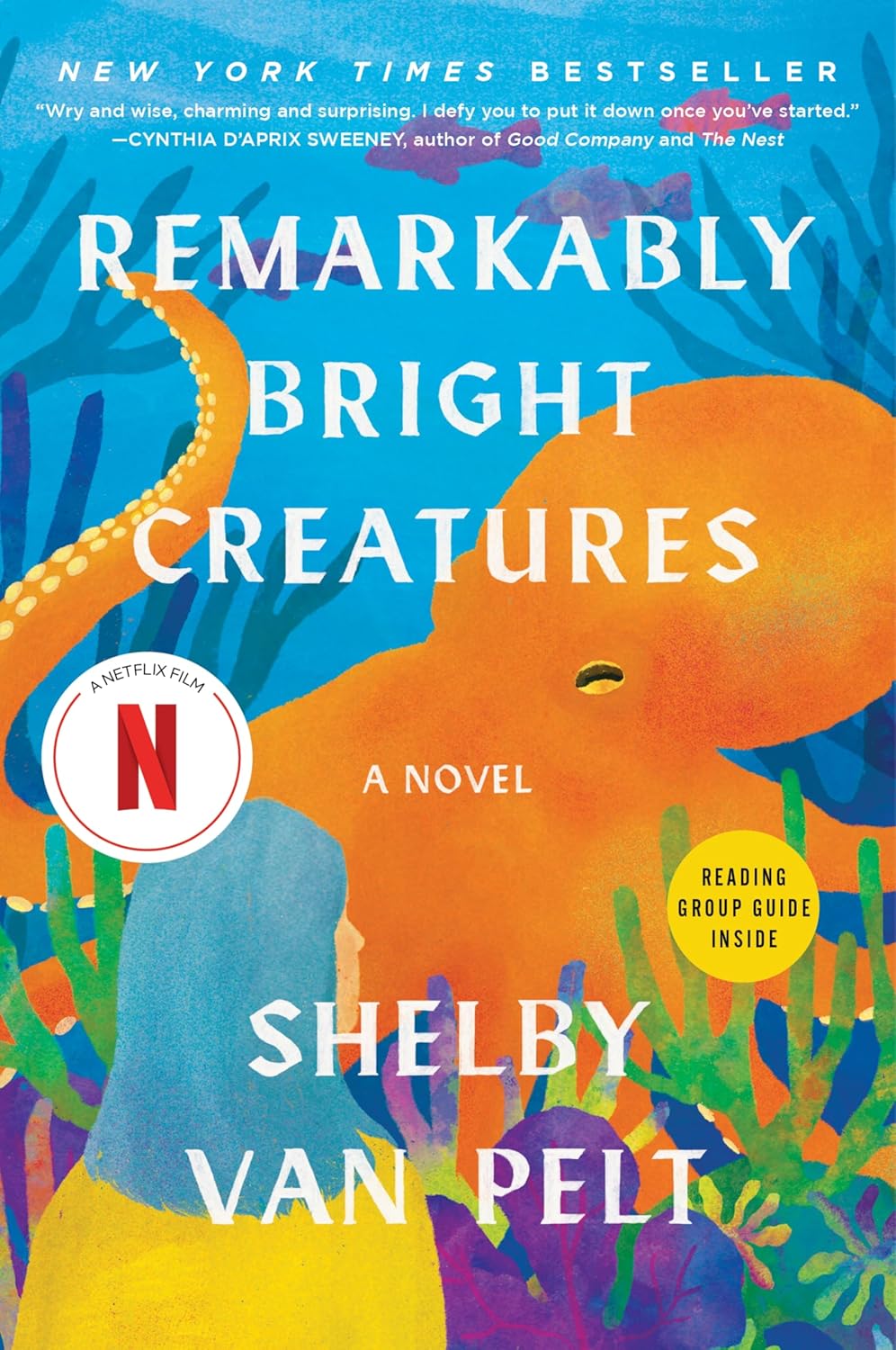
Aquatic Empathy and Human Solitude: Introduction
Every few years, a debut novel arrives with a premise so distinct it risks sounding gimmicky, only to subvert expectations through sheer emotional resonance. Remarkably Bright Creatures by Shelby Van Pelt is precisely that rare gem. Balancing on the delicate line between contemporary realism and subtle magical realism, this novel challenges our understanding of grief, late-stage life transitions, and the cognitive landscapes of non-human species. Much like Fredrik Backman’s A Man Called Ove combined with the ecological tenderness of The Soul of an Octopus, Van Pelt weaves a narrative that feels both fiercely localized in the Pacific Northwest and universally accessible.
Remarkably Bright Creatures At a Glance: Key Details
| Book Title | Genre | Target Audience | Anwar Library Rating |
|---|---|---|---|
| Remarkably Bright Creatures | Contemporary Fiction / Mystery-Drama | Fans of character-driven prose, cozy mysteries, and emotional family dramas. | 4.8 / 5.0 |
The Ghost of Sowell Bay: Plot Summary of Remarkably Bright Creatures (No Spoilers)
The story unfolds in the quiet, damp coastal town of Sowell Bay, Washington. We meet Tova Sullivan, a seventy-year-old woman who copes with her profound isolation by working the night shift as a cleaning lady at the local Sowell Bay Aquarium. Tova is a woman defined by her absences: her husband, Will, passed away a few years prior, and her eighteen-year-old son, Erik, vanished mysteriously on a boat in Puget Sound over thirty years ago. Tova scrubs floors and polishes glass not for the meager paycheck, but to keep her mind from sinking into the stagnant waters of her unhealed trauma.
Enter Marcellus McSquiddles, a giant Pacific octopus nearing the natural end of his four-year lifespan. Marcellus is a captive philosopher—curious, fiercely intelligent, cynical, and deeply observant of the “human biped” specimens who stare at him through the glass. He spends his nights escaping his tank to forage for contraband snacks like sea cucumbers from neighboring displays, keeping a meticulous mental tally of human quirks. When Tova rescues Marcellus from a dangerous late-night entanglement in electrical cords, a silent, profound understanding forms between the neat-freak octogenarian and the brilliant, multi-hearted cephalopod.
Parallel to Tova’s quiet routine is Cameron Cassmore, a chaotic, directionless thirty-year-old musician from California who has failed at nearly every venture he has attempted. Raised by his eccentric aunt after his drug-addicted mother abandoned him at a trailer park, Cameron discovers a vintage class ring among his mother’s old belongings. Believing the ring belongs to a wealthy real estate mogul who might be his biological father, Cameron uses his last few dollars to catch a bus to Sowell Bay. As Cameron’s desperate hunt for identity collides with Tova’s calculated solitude, Marcellus watches from his tank, deducing a crucial piece of the puzzle that neither human can see.
The Multi-Hearted Connection: Remarkably Bright Creatures Ending Explained & Plot Twists (Spoilers)
Click to expand the deep-dive spoiler zone
🚨 WARNING: Major Spoilers Ahead! Do not expand this section unless you have finished the book.
The emotional climax of the novel centers on Marcellus’s remarkable deductive capabilities. Through his nighttime scavenges and keen observation of human keepsakes, Marcellus recognizes the class ring Cameron carries and remembers a distinctive key charm that Tova’s lost son, Erik, owned. Marcellus pieces together the biological timeline and realizes a truth that human defense mechanisms have blinded Tova and Cameron from seeing: Cameron is not the son of the wealthy real estate developer; he is the biological son of Erik Sullivan, making Tova his biological grandmother.
Marcellus works tirelessly to communicate this before his failing health completely gives out. He orchestrates a series of intentional clues, physically dragging evidence across his glass enclosure to prompt Tova to look closer at Cameron’s background. Tova eventually discovers the truth, realizing that while her son Erik died by tragic drowning all those years ago, he left behind a piece of himself—Cameron—who desperately needs a family just as much as Tova does.
The resolution is bittersweet. Tova, acknowledging Marcellus’s declining health and imminent natural death, executes one final, daring act of love. She breaks aquarium protocol to help transport Marcellus back to the open waters of the Puget Sound. Marcellus gets to experience the vast, dark freedom of the ocean one last time before his life cycle completes, dying in peace. Tova and Cameron choose to move past their respective walls of resentment and grief, stepping into the future together as a restored family unit.
The Rhythm of the Tide: Critical Assessment of the Novel
The “Real Talk”: Pacing, Prose, and Impact
Van Pelt’s narrative engine runs on a multi-POV structure that could easily falter under less steady hands. The transition between Tova’s third-person domestic observations, Cameron’s often frustratingly immature first-person rants, and Marcellus’s haughty, hyper-intelligent inner monologues creates a unique reading cadence. The author avoids the trap of cartoonish anthropomorphism; Marcellus doesn’t feel like a Disney sidekick, but rather an ancient, alien consciousness bound by an ironic affection for a single human.
If there is a flaw in the novel’s design, it lies in the structural transparency of the central mystery. Experienced readers of contemporary drama will decipher the biological connection between Cameron and Tova long before the characters do. This creates a pacing drag in the middle chapters, where the audience is forced to wait for Cameron to grow up and look past his immediate nose. However, Van Pelt compensates for this structural predictability with exquisite prose and a profound understanding of sensory details—the scent of brine, the rhythmic clack of Tova’s knitting needles, and the cold, rubbery touch of a tentacle against aged skin.
The Armor of Routine vs. Alien Intellect: In-Depth Character Analysis
Tova Sullivan stands as a masterful portrayal of Scandinavian stoicism processing long-term, unresolved grief. She doesn’t scream at the universe; instead, she channels her sorrow into impeccably wiped countertops and a polite distance from her friend group, the “Knitting Nitwits.” Her character arc is not about moving on from her son’s death, but about opening her tightly controlled ecosystem to the messiness of new family ties.
Marcellus serves as the narrative’s emotional anchor and objective mirror. With nine brains and three hearts, his existential weariness matches Tova’s, but his lack of human ego allows him to see the truth clearly. His affection for Tova is built entirely on mutual respect: she is the only human who doesn’t treat him like a brainless attraction, recognizing his autonomy and intelligence.
Cameron Cassmore acts as the narrative foil to Tova’s rigid discipline. He is impulsive, externalizes blame, and hides behind a shield of cynicism. His character growth is painful to watch at times, but his transformation from a boy running from responsibility to a young man accepting his heritage provides the story with its ultimate sense of balance.
Atmospheric Chemistry: Vibe Check
Briny and Melancholic: The overcast, foggy backdrop of the Pacific Northwest mirrors the heavy, unresolved grief hanging over the characters.
Warmly Consoling: Despite dealing with death, abandonment, and aging, the tone remains deeply comforting, offering hope without resorting to cheap sentimentality.
Wryly Observant: Marcellus’s commentary injects a sharp, dry wit that keeps the story from ever feeling bogged down by its sadder themes.
The Invisible Nets of Captivity: Themes & Motifs Deep Dive
The central metaphor of the novel is captivity. Marcellus is physically captive within his glass tank, counting down the days until his inevitable demise. Tova is emotionally captive inside her home and her immaculate routines, trapped by the ghost of her missing son. Cameron is trapped within his cycle of childhood abandonment and low self-esteem. Van Pelt brilliantly demonstrates that true liberation doesn’t just come from breaking physical barriers—as seen in Tova setting Marcellus free—but from breaking open the psychological vaults we construct to protect ourselves from being hurt again.
Communication, or rather the lack thereof, operates as another vital motif. The human characters routinely fail to speak their truths, misinterpreting texts, leaving letters unread, and harboring assumptions. Conversely, the most profound communication in the book happens without words—through the silent gaze between an old woman and a cephalopod, demonstrating that empathy transcending language can mend bonds that human words have fractured.
Sailing in Familiar Waters: Target Audience Guide
This novel is a definitive must-read for readers who appreciate the emotional architecture of Elizabeth Strout’s Olive Kitteridge or the quirky, small-town dynamics found in the works of Gail Honeyman. If you enjoy narratives where the setting serves as a character itself, and where unconventional friendships are the catalyst for deep psychological healing, Remarkably Bright Creatures will sit comfortably on your favorite bookshelf. It is an exceptional pick for book clubs due to its multi-layered discussion points regarding eldercare, maternal grief, and animal consciousness.
If You Loved This Drama: Similar Recommendations
A Man Called Ove by Fredrik Backman: Shares the poignant dynamic of an aging protagonist trapped in rigid routines who finds a renewed lease on life through an unexpected connection with their community.
The Soul of an Octopus by Sy Montgomery: For readers who want to explore the non-fiction, real-world science and emotional depth behind cephalopod intelligence and their capacity to form bonds with humans.
The House in the Cerulean Sea by TJ Klune: Offers a similar cozy, coastal aesthetic combined with found-family dynamics and a gentle, redemptive narrative arc.
The Cephalopod Phenomenon: Cultural Impact and Reader Reactions
Since its release, Remarkably Bright Creatures has achieved explosive success across digital reading ecosystems, most notably on BookTok and Goodreads, where it maintains an exceptionally high rating over hundreds of thousands of reviews. It was selected as a Jenna Bush Hager Today Show Book Club Pick, solidifying its place in contemporary popular culture. Readers consistently note that while they initially picked up the book for the novelty of a talking octopus, they stayed for the raw, tear-jerking exploration of found family and late-life purpose.
About the Author: Shelby Van Pelt
Shelby Van Pelt born and raised in the Pacific Northwest, drew directly from her childhood memories of visiting public aquariums in Seattle to craft the vivid, moist atmosphere of Sowell Bay. Remarkably Bright Creatures marks her spectacular debut into the literary world. Her background in creative writing and her deep-seated fascination with marine biology converged during a writing workshop where she challenged herself to write from the perspective of an animal, eventually giving birth to the beloved character of Marcellus. She currently resides in the Midwest with her family.
Frequently Asked Questions (FAQ)
Is Remarkably Bright Creatures a sad book?
While it addresses heavy themes of grief, loss, and the death of a beloved animal companion, the overall tone is uplifting, focusing heavily on healing, reconciliation, and new beginnings.
Does the octopus actually talk in the book?
Marcellus does not speak out loud to the human characters. Instead, his voice is delivered to the reader via internal monologues that reveal his thoughts, deductions, and unique perspective on human behavior.
Is Sowell Bay a real place?
Sowell Bay is a fictional town created by Shelby Van Pelt, though it is heavily inspired by real coastal towns located along the Puget Sound in Washington State.
Where to Buy & Read
Ready to immerse yourself in this unputdownable book? Use the verified, functional search retail links below to find the best deals on physical, digital, or audio editions: