
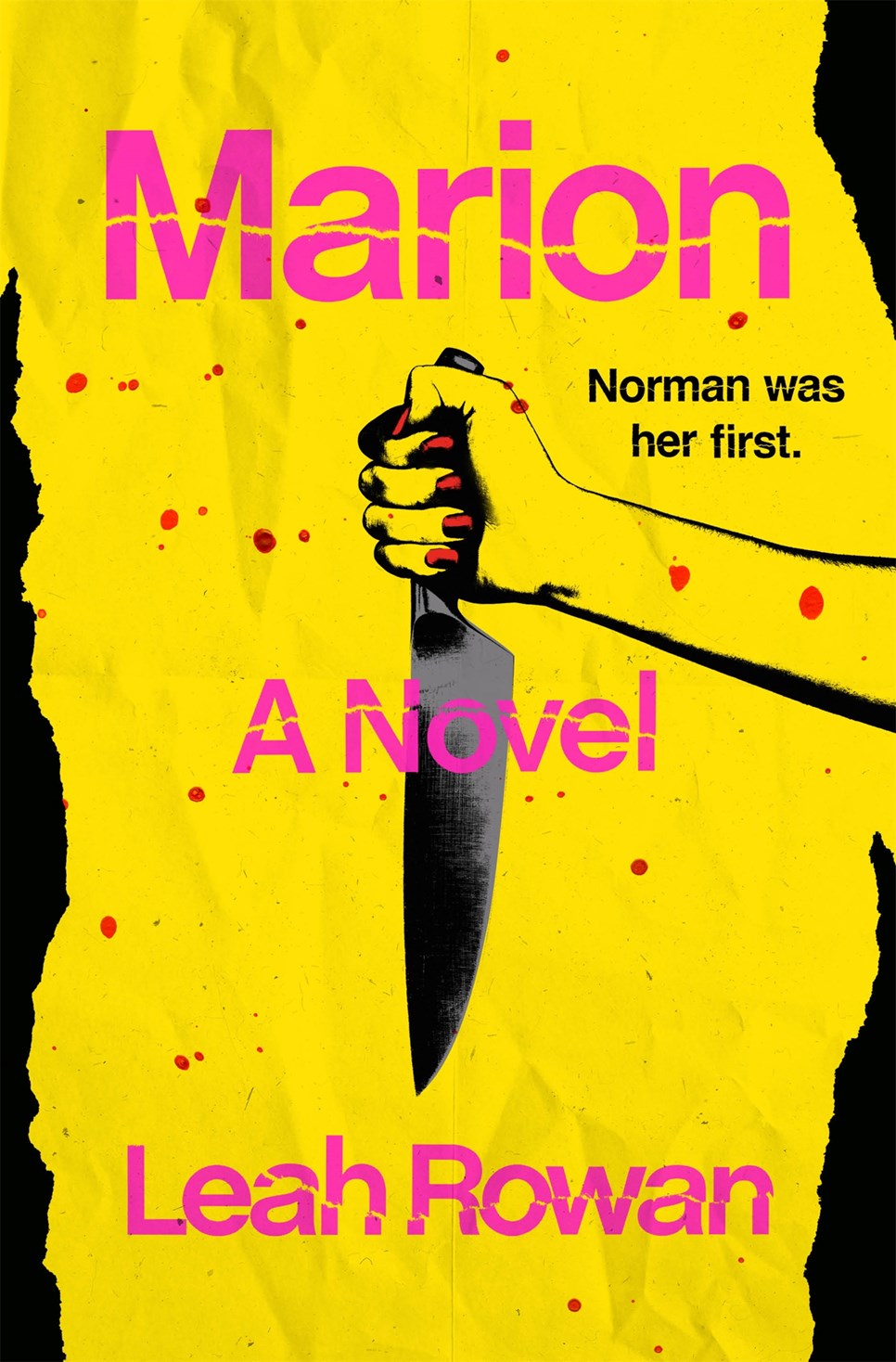
The Dead Blonde Strikes Back: Introduction
In 1960, Alfred Hitchcock fundamentally altered the topography of cinematic horror by doing the unthinkable: slashing down his leading lady forty minutes into Psycho. For decades, the image of the helpless blonde bleeding out in a sterile motel shower became the ultimate blueprint for female victimization in the slasher genre. Enter Marion by Leah Rowan. This brilliant debut novel doesn’t just pay homage to the classic; it violently detonates its foundations. By treating the legendary shower scene not as an ending, but as a catalyst for a manic, empowering, and deeply twisted crime spree, Rowan creates a contemporary thriller that stands proudly alongside modern subversions like Gillian Flynn’s Gone Girl and Mona Awad’s Bunny.
Marion At a Glance: Key Details
| Book Title | Genre | Target Audience | Anwar Library Rating |
|---|---|---|---|
| Marion | Feminist Psychological Thriller / Horror | Readers obsessed with dark subversions, anti-heroine leads, and fast-paced domestic suspense. | 4.9 / 5.0 |
Blood on the White Ceramic: Plot Summary of Marion (No Spoilers)
The story follows an overworked, heavily underestimated Manhattan ad agency employee who is pushed to her absolute limit. Grief-stricken by the recent passing of her mother—a fierce advocate who spent her life managing women’s shelters—our protagonist discovers a horrifying reality: her older sister, Lauren, is trapped in a violently abusive, controlling marriage. Desperate to save Lauren but lacking the financial capital to fund a legal escape, a sudden and morally gray window opens. Her corrupt corporate manager tasks her with handling an illicit transaction involving one hundred thousand dollars in cold cash. Instead of depositing it into his hidden accounts, she packs the money into a bag, deserts her life in New York City, and flees toward Saratoga Springs to rescue her sister.
Fate, however, has a notoriously cruel sense of humor. Mid-journey, her escape bus suffers a catastrophic breakdown in a remote upstate town. With local inns completely occupied by stranded travelers, she is forced to seek shelter at the isolated Billings Hotel on the dark outskirts of town. There she meets Norm Billings, an eccentric, soft-spoken young innkeeper who seems overly attached to his frail, unseen mother. Exhausted and carrying the heavy burden of her theft, she steps into her room’s shower to wash away the late-summer humidity.
The curtain is ripped open. Norm stands there, knife raised, ready to turn her into another tragic statistic. But our protagonist wasn’t raised to be a victim. Armed with self-defense instincts passed down by her mother, she blindsides Norm, wrests the weapon from his grip, and turns the blade upon her attacker. Norm dies on the tile floor. Suddenly, she is no longer just a desperate woman running from a corporate theft; she is a killer with a corpse to bury, a bag of stolen money, and an abusive brother-in-law still left to deal with. What follows is a lightning-fast, high-stakes game of survival as she goes fully on the run, altering her identity to “Marion” while a meticulous private investigator named Hannah Pierce begins picking up her bloody trail.
The Billings Family Crypt: Marion Ending Explained & Plot Twists (Spoilers)
Click to expand the deep-dive spoiler zone
🚨 WARNING: Major Spoilers Ahead! Do not expand this section unless you have finished the book.
The final third of the novel completely upends the traditional Psycho narrative architecture through a series of dual-POV revelations between Marion and investigator Hannah Pierce. As Hannah investigates the disappearance of another girl, Emily Stockton, she tracks the clues directly back to the Billings Hotel, only to find Norman missing and the blood-cleaned shower. Meanwhile, Marion has used the $100,000 to systematically dismantle her sister Lauren’s abusive husband, staging an intricate trap that eliminates him while making it look like a domestic desertion.
The ultimate plot twist reveals the truth about Norm’s “elderly mother.” When Hannah finally gains access to the private residence behind the hotel, she expects to find a mummified corpse or a split-personality manifestation. Instead, Rowan reveals that Norm’s mother was alive, but she was a calculated accomplice and the true architect behind the motel’s history of predatory violence against young women traveling alone. Norm was merely her physical weapon.
In a breathtaking confrontation, Marion returns to the hotel to completely burn down her tracks, crossing paths with both Hannah and Mother Billings. Rather than allowing herself to be captured or framed, Marion manipulates the situation with terrifying brilliance. She executes Mother Billings, framing the entire historic string of motel murders entirely on the dead Billings family, effectively cleansing her own legal record. Hannah, recognizing the systemic systemic failures that drove Marion to violence and discovering the horrifying truth of what the Billings family did to other missing girls, chooses to alter her investigative report. The book closes with Marion and Lauren successfully vanished into a new life of absolute autonomy, funded by the stolen cash, leaving the reader to reckon with the moral ambiguity of a heroine who found her true, dark potential through the act of survival.
Savage Action vs. Manic Prose: Critical Assessment of the Novel
The “Real Talk”: Pacing, Prose, and Impact
Leah Rowan’s debut achieves something extraordinary: it maintains a breathless, breakneck pace while displaying a calculated control over narrative tension. The prose has an intentionally frenetic, manic quality that perfectly mirrors Marion’s psychological state. Rowan writes sentences that feel sharp, jagged, and urgent, forcing the reader into the claustrophobic headspace of a woman who realizes she might actually enjoy the violent agency she has suddenly uncovered. The dialogue cracks with a deliciously grim sense of dark humor, preventing the heavy topics of domestic abuse from turning the book into an unreadable slog.
However, purists of standard procedural structures might find the dual-POV shift to Hannah Pierce slightly jarring in the middle chapters. While Hannah is a far more competent, deeply realized character than Hitchcock’s original investigator Arbogast, her analytical, law-abiding perspective briefly cools down the burning momentum established by Marion’s chaotic crime spree. Fortunately, this minor structural speedbump is redeemed by the final acts, where Rowan masterfully merges both timelines into a explosive, emotionally satisfying climax that challenges conventional tropes about heroes, villains, and the morality of self-defense.
The Evolution of a Radical Weapon: In-Depth Character Analysis
Marion (The Protagonist) is a tour de force character study in repressed female rage. She begins as an underappreciated, invisible urban worker but rapidly mutates into a calculating strategist. What makes her compelling is her lack of immediate remorse; she doesn’t spend chapters weeping over killing Norm. Instead, she experiences a dark, existential awakening, questioning whether she was always a deeply dangerous person simply waiting for the perfect catalyst to unleash her power.
Hannah Pierce serves as the perfect narrative anchor and intellectual foil to Marion. As a fledgling private investigator trying to prove her worth to a dismissive corporate law firm and traditional parents, Hannah’s journey is about uncovering her own internal strength. Unlike standard thriller detectives who function as flat plot devices, Hannah’s professional evolution parallels Marion’s criminal awakening.
Norm Billings is reimagined not as an enigmatic, untouchable mastermind, but as an initial, clumsy obstacle. Rowan strips away the romanticized mystique often granted to cinematic serial killers, portraying him as a broken, pathetic product of domestic programming who is completely unprepared for a target who actively swings the weapon back.
Atmospheric Chemistry: Vibe Check
Wickedly Cathartic: The narrative delivers an intense, raw surge of adrenaline as systemic victims completely reclaim their power through visceral justice.
Neon-Noir and Grimy: The setting evokes the damp, isolated feeling of late-summer upstate New York, heavy with the smell of old wood, cheap cleaning chemicals, and rain-soaked asphalt.
Sardonically Sharp: A dark, biting undercurrent of humor runs through Marion’s internal monologues, analyzing societal expectations of women even while wiping down a crime scene.
The Inherited Shield of Rage: Themes & Motifs Deep Dive
The primary thematic pillar of Marion is the anatomy of female rage and its historical suppression. Rowan systematically examines how society conditions women to absorb microaggressions, unwanted advances, and domestic terror with quiet endurance. Marion’s physical reversal of the knife strike symbolizes a collective, historical breaking point. Her violence isn’t portrayed as senseless insanity, but as a rational, defensive adaptation to an indifferent socio-legal ecosystem that routinely fails to protect vulnerable women.
Sisterhood operates as the novel’s core emotional motif. The bond between Marion and Lauren, anchored by the lingering ideological teachings of their late mother, acts as the moral justification for every law broken. Rowan expands this concept beyond biological ties, exploring a broader, subtextual sisterhood between Marion and the investigator chasing her, suggesting that the shared baseline experiences of navigating a patriarchal world can create unspoken alliances that transcend conventional definitions of law and order.
Reclaiming the Final Girl: Target Audience Guide
This novel is a mandatory addition to the shelves of readers who devour feminist revenge thrillers like Chelsea G. Summers’ A Certain Hunger or the sharp, cinematic horror-satires of Rachel Harrison. If you are an avid cinephile who enjoys deconstructing classical Hollywood tropes, or if you simply appreciate psychological suspense where the female characters refuse to be passive victims, Rowan’s debut will leave you completely mesmerized. It serves as an incredible selection for book clubs looking to spark intense debates regarding morality, systemic justice, and literary adaptation.
If You Loved This Drama: Similar Recommendations
Natural Beauty by Ling Ling Huang: A dark, surreal look at the physical and psychological costs extracted from women by modern societal expectations, wrapped in a tense, thriller framework.
Black Sheep by Rachel Harrison: Offers a similarly wicked sense of grim humor, complex family dynamics, and a fierce, unconventional heroine fighting against dark domestic traps.
The Writing Retreat by Julia Bartz: Perfect for readers who want to sustain that high-tension, claustrophobic atmosphere featuring complicated female relationships and intense psychological stakes.
The BookTok Slasher Awakening: Cultural Impact and Reader Reactions
Upon its publication by St. Martin’s Press, Marion instantly ignited massive waves of viral engagement across Goodreads and BookTok, quickly tracking as a Most Anticipated Summer Selection. Literary critics have lauded the book as a “diabolically clever feminist remix,” earning starred reviews from major trade publications like Library Journal and Booklist. Readers consistently rave about the shocking subversion of the iconic shower sequence, celebrating the novel for providing long-overdue cinematic justice to a character that pop culture spent generations celebrating as a beautiful corpse.
About the Author: Leah Rowan
Leah Rowan is an exciting new voice in contemporary psychological horror and suspense fiction. Splitting her time between Brooklyn and the scenic, isolated landscapes of the Catskills, she draws heavily upon her deep, lifelong love for classic cinema, Hitchcockian suspense, and golden-age horror films. As an essayist and regular contributor to platforms like CrimeReads, Rowan has spent years studying genre tropes, culminating in her explosive debut novel, Marion. She lives with her husband, two daughters, and their rescue dog, Wally.
Frequently Asked Questions (FAQ)
Do I need to watch Hitchcock’s Psycho to understand Marion?
Not at all. While watching the 1960 film or reading Robert Bloch’s original book deepens the appreciation for Leah Rowan’s clever Easter eggs and reversals, the novel is fully self-contained, working perfectly as a modern standalone psychological thriller.
Is Marion a traditional horror novel with supernatural elements?
No, the book contains no supernatural elements. It is a grounded, psychological crime thriller and domestic suspense novel, though it utilizes the high-tension pacing, visceral atmosphere, and structural elements of the slasher genre.
How graphic is the violence in the book?
The novel features some moments of sharp, intense violence—particularly during the initial self-defense scene in the shower and the final confrontations—but it focuses far more heavily on psychological strategy, suspense, and character evolution than random gore.
Where to Buy & Read
Ready to immerse yourself in this unputdownable book? Use the verified, functional search retail links below to find the best deals on physical, digital, or audio editions: