
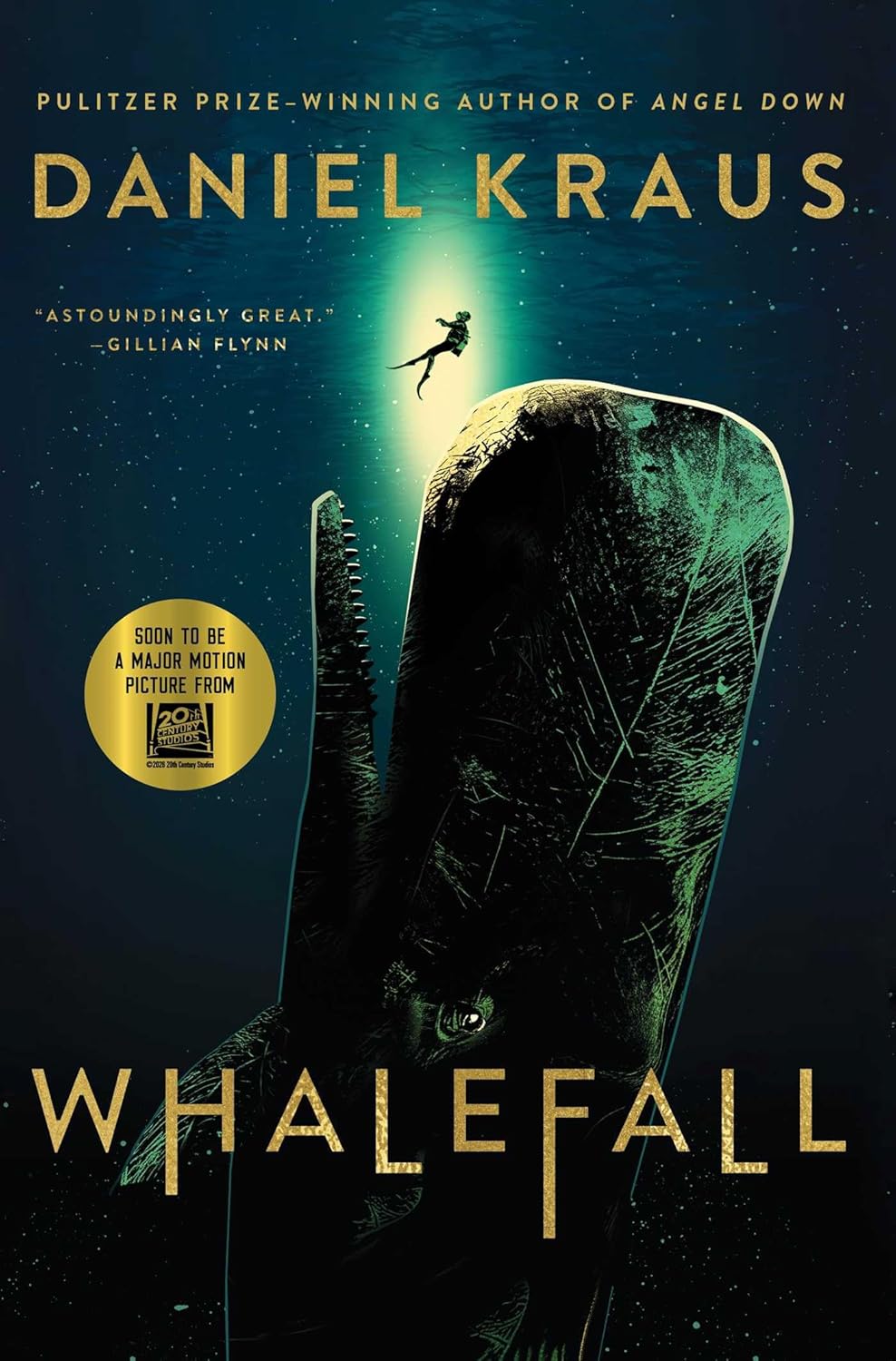
The Abyssal Pressure of Guilt: Introduction
Imagine the claustrophobic dread of Andy Weir’s The Martian stripped of its optimistic engineering, smashed together with the biblical, mythic horror of Jonah and the Whale. Whalefall by Daniel Kraus is a relentlessly paced, biologically meticulous survival thriller that plunges readers into the ultimate biological prison: the stomach of a sixty-foot, eighty-ton sperm whale. Published to immense critical acclaim, this high-concept novel blends hyper-realistic marine science with a devastating psychological exploration of filial grief. It is an unsparing look at how far a human being will go to survive when their internal oxygen supply—both literally and emotionally—is ticking down to zero.
Whalefall At a Glance: Key Details
| Book Title | Genre | Target Audience | Anwar Library Rating |
|---|---|---|---|
| Whalefall | Sci-Fi Survival Thriller | Fans of hard sci-fi, claustrophobic horror, and emotional family dramas | 4.7 / 5.0 |
The Oceanic Abyss and the Diver’s Descent: Plot Summary of Whalefall (No Spoilers)
The narrative centers on Jay Young, a seventeen-year-old scuba diver who has spent his entire life under the tyrannical, demanding shadow of his larger-than-life father, Mitt Young. Mitt was a legendary, fanatical diver who loved the Pacific Ocean more than his own family, ultimately pushing himself to a tragic, self-inflicted end off the coast of California. Driven by a volatile cocktail of guilt, anger, and a desperate need for closure, Jay sets out on a solo, unsanctioned dive into the treacherous waters of the Monterey Canyon. His singular, dangerous mission is to recover his father’s skeletal remains from the ocean floor before they are lost to the abyss forever.
However, the deep ocean tolerates no mistakes. While operating hundreds of feet below the surface, a sudden, freak encounter with a colossal giant squid triggers a cascade of catastrophic events. The squid attracts a massive, hunting sperm whale. In the chaotic, swirling underwater battle between the two apex predators, Jay becomes accidental collateral damage. In one horrific, pressurized moment, Jay is vacuumed into the apex predator’s massive maw and swallowed alive. Stranded inside the first stomach compartment of the leviathan, injured, and rapidly losing light, Jay is forced to confront a terrifying mathematical reality: he has exactly one scuba tank containing roughly eighty minutes of breathable air to engineer an impossible escape from a living, digesting prison.
The Expulsion from the Biological Underworld: Whalefall Ending Explained & Plot Twists (Spoilers)
Click to expand the deep-dive spoiler zone
🚨 WARNING: Major Spoilers Ahead! Do not expand this section unless you have finished the book.
Jay’s escape from the interior of the sperm whale is a masterpiece of gritty, scientifically informed body-horror and structural problem-solving. Trapped inside the stomach, Jay must navigate the acidic, churning environment while battling severe oxygen depletion, carbon dioxide toxicity, and crushing psychological hallucinations of his deceased father, Mitt. He quickly realizes that the whale cannot simply spit him out; the creature’s complex, multi-chambered digestive tract and muscular sphincters prevent straightforward regurgitation.
The ultimate turning point comes when Jay understands that his only hope is to induce a violent, unnatural vomiting reflex within the whale. Utilizing the remaining tools at his disposal, including his dive knife, weight belt, and the highly volatile mechanics of his scuba regulator, Jay intentionally triggers a chemical and physical reaction within the whale’s stomach lining. He uses his father’s deeply ingrained survival teachings—the very lessons he resented—to calculate the exact pressure changes needed to force the whale’s esophageal muscles to contract backward.
In a breathless, agonizing climax, Jay deliberately forces his remaining oxygen equipment to over-pressurize, creating an explosive blast of compressed air within the stomach chamber. The agonizing pressure forces the sperm whale to breach the surface of the ocean in a violent spasm, purging its stomach contents. Jay is violently expelled out into the open air alongside the carcass of the giant squid. Severely injured, suffering from decompression sickness (the bends), and on the verge of drowning, Jay is rescued at the last possible second. The true emotional twist lies in Jay’s psychological survival: by using his father’s harsh teachings to save his own life, he finally forgives his father and releases the crushing weight of his guilt, transforming the titular “whalefall” into a metaphor for rebirth.
Visceral Claustrophobia vs. Mathematical Pacing: Critical Assessment of the Novel
The “Real Talk”: Pacing, Prose, and Impact
Daniel Kraus delivers an absolute masterclass in high-concept tension. The book’s structure is brilliantly designed as a literal countdown, with chapter titles indicating the dwindling percentage of oxygen left in Jay’s tank. This structural choice infuses the narrative with an urgent, breathless momentum that makes it almost impossible to set down. Kraus avoids the trap of generic thriller prose by anchoring the surreal premise in hyper-realistic marine biology, cetacean anatomy, and the physics of deep-sea diving. The descriptions of the whale’s internal organs, the shifting gases, and the tactile horror of the stomach walls are rendered with a vivid, grotesque beauty that feels incredibly authentic.
If there is a minor flaw in the novel’s pacing, it lies in the frequent use of flashbacks. To ground the emotional stakes, Kraus regularly cuts away from the immediate horror of the whale’s stomach to explore Jay’s tumultuous past with his abusive, obsessive father. While these psychological interludes are essential for character development, readers who are fully invested in the high-stakes survival mechanics might find these shifts momentarily disruptive to the propulsive, real-time narrative engine. However, the emotional payoff in the third act successfully sews these two threads together, proving that the psychological cage was just as dangerous as the biological one.
The Anatomy of Inheritance: In-Depth Character Analysis
The character dynamics in Whalefall operate on a deeply psychological level, moving far beyond standard thriller archetypes. The conflict is less about man versus nature and more about a son versus the spectral memory of his father.
- Jay Young: At the start of the novel, Jay is defined entirely by his resentments and perceived inadequacies. He is not a traditional superhero protagonist; he is a broken, grieving teenager who believes he is walking toward his own death. Inside the whale, his evolution is stark. He must transform from a passive victim of his father’s trauma into an active agent of his own survival, systematically cataloging his options with scientific precision.
- Mitt Young: Though dead before the first chapter begins, Mitt hovers over every page like an oppressive marine deity. He was a man consumed by the sublimity of the ocean, treating his children with a military-grade harshness disguised as survival training. Through Jay’s shifting memories, Mitt evolves from a terrifying antagonist into a tragic, deeply flawed human being whose destructive obsession ultimately provided his son with the exact mental tools required to survive the impossible.
Atmospheric Chemistry: Vibe Check
Suffocating: The relentless focus on atmospheric pressure, rising carbon dioxide levels, and pitch-black darkness creates an intense, physical sensation of claustrophobia that lingers with the reader.
Clinical: Kraus uses precise, hard scientific data regarding scuba mechanics and whale anatomy to make an extraordinary, mythical premise feel terrifyingly real and plausible.
Melancholic: Beneath the rapid-fire survival beats beats a deeply sorrowful, elegiac heart centered on family trauma, abandonment, and the heavy tax of unspoken love.
The Leviathan as a Mirror: Themes & Motifs Deep Dive
The central, shining motif of the novel is the concept of a whalefall—the natural phenomenon where a whale dies and its massive carcass sinks to the barren ocean floor, providing a sudden, massive ecosystem that sustains thousands of deep-sea life forms for decades. Kraus elevates this biological event into a profound metaphor for parenthood. Mitt Young’s destructive life and subsequent death are a literal whalefall for his family; his demise crushes them, yet the dark legacy he leaves behind ultimately provides Jay with the exact nutrients—the knowledge, resilience, and drive—necessary to sustain his own life.
Additionally, the novel engages deeply with the archetypal motif of the belly of the whale. Drawing clear parallels to classic myths, Kraus treats the sperm whale’s stomach not merely as a setting for physical danger, but as a transformative, chthonic crucible. Jay must be completely swallowed by the ocean, stripped of light, air, and external hope, to fully confront the internalized ghost of his father. His escape is a literal regurgitation, but a spiritual resurrection.
Navigating the Currents: Target Audience Guide
Whalefall is custom-built for readers who demand high-stakes, realistic tension paired with genuine emotional gravity. If you found yourself fascinated by the grueling, step-by-step problem-solving of Andy Weir’s The Martian or the terrifying, isolated aquatic suspense of Peter Benchley’s Jaws, this book will speak directly to you. It will also resonate strongly with audiences who appreciate dark, literary explorations of family trauma and grief, such as the works of Cormac McCarthy. It is highly recommended for anyone looking for a thriller that treats science with absolute respect while delivering a powerful emotional punch.
If You Loved This Drama: Similar Recommendations
The Deep by Nick Cutter: If the pitch-black, claustrophobic ocean setting of Whalefall kept your pulse pounding, this psychological horror novel offers a darker, supernatural descent into the deepest trench on Earth.
The Martian by Andy Weir: For readers who thoroughly enjoyed Jay’s systematic, science-based approach to surviving an environments completely hostile to human life using limited resources.
In the Heart of the Sea by Nathaniel Philbrick: A non-fiction account of the whaleship Essex that provides the real-world, historical weight of sperm whale encounters and the limits of human endurance at sea.
The Digital Breach: Cultural Impact and Reader Reactions
Since its release, Whalefall has ignited significant waves across online literary communities, becoming a major talking point on BookTok and Goodreads. Readers consistently praise the novel for its unrelenting tension, with many noting that the book induced genuine physical anxiety and claustrophobia. The meticulously researched marine biology has earned high marks from science enthusiasts, who appreciate Kraus’s commitment to realism over easy Hollywood tropes. While a small subset of readers express mixed feelings about the structural frequency of the emotional flashbacks, the overwhelming consensus positions the book as a modern survival classic, celebrated for its unique premise and hauntingly beautiful ending.
About the Author: Daniel Kraus
Daniel Kraus is a New York Times bestselling author known for his incredible versatility across horror, suspense, and speculative fiction. An acclaimed figure in the industry, Kraus co-authored the epic horror novel The Living Dead alongside legendary filmmaker George A. Romero, and collaborated with visionary director Guillermo del Toro on the novelization of the Academy Award-winning film The Shape of Water as well as the hit series Trollhunters. His solo work is celebrated for its rich, atmospheric depth and intense psychological stakes. Kraus’s profound fascination with formatting high-concept premises through a lens of strict realism shines brilliantly throughout his extensive catalog.
Frequently Asked Questions (FAQ)
Is the scientific premise of Whalefall actually possible?
While a sperm whale’s esophagus is theoretically large enough to swallow a human adult whole (unlike baleen whales, which have very narrow throats), a human would instantly face crushing muscular contractions, a complete lack of oxygen, and highly toxic digestive acids. Whalefall stretches reality just enough to make the narrative happen, but grounds every subsequent survival detail in real, accurate science.
Does Whalefall contain a lot of gore or body horror?
Yes, the novel features intense, visceral descriptions of the interior of the whale’s digestive tract, the effects of stomach acid on diving gear and human skin, and the raw physical trauma of decompression sickness. It is highly atmospheric and graphic, but never feels gratuitous.
How fast is the pacing of the book?
The pacing is exceptionally fast. Because the chapters act as a literal countdown based on the remaining oxygen percentage in Jay’s scuba tank, the story maintains a breathless, real-time urgency that makes it a perfect one- or two-sitting read.
Where to Buy & Read
Ready to immerse yourself in this unputdownable book? Use the verified, functional search retail links below to find the best deals on physical, digital, or audio editions: