
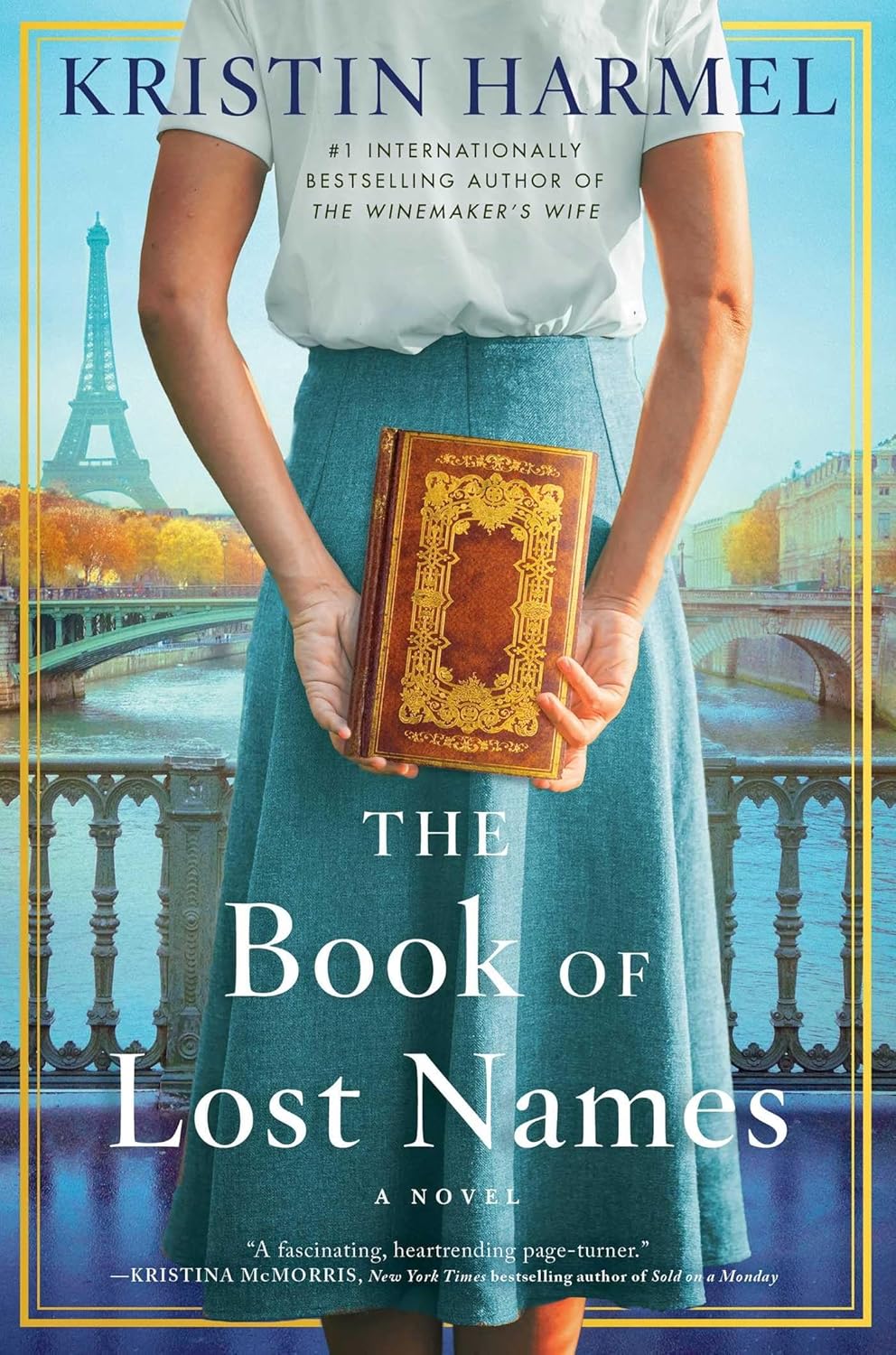
The Paper Trail of Survival: Introduction
In the vast landscape of World War II historical fiction, finding a fresh vantage point can feel as challenging as navigating occupied territory without papers. However, The Book of Lost Names by Kristin Harmel carves out a remarkably evocative, high-stakes space that stands tall alongside modern classics like The Nightingale or The Tattooist of Auschwitz. Rather than focusing solely on the tactical front lines or the stark horrors of the concentration camps, Harmel turns her gaze toward the quiet, mathematical, and artistic underground world of document forgery.
The novel masterfully balances the psychological weight of identity erasure with the thrilling velocity of a classic espionage narrative. It demonstrates how a bottle of tea-stained ink, a chemical eraser, and a razor blade could become weapons of resistance every bit as lethal as an Allied rifle. For readers who enjoy exploring the intersection of female agency, historical trauma, and hidden wartime networks, this book promises an emotionally resonant journey through one of humanity’s darkest hours.
The Book of Lost Names At a Glance: Key Details
| Book Title | Genre | Target Audience | Anwar Library Rating |
|---|---|---|---|
| The Book of Lost Names | Historical Fiction / WWII Drama | Fans of emotional wartime survival, hidden history enthusiasts, and book clubs | 4.7 / 5.0 |
Erasure as Salvation: Plot Summary of The Book of Lost Names (No Spoilers)
The narrative unfolds across a dual timeline, opening in 2005 with Eva Traube Abrams, a semi-retired librarian in Florida. While shelving books, her eye catches a photograph in a magazine article detailing a mysterious volume from World War II: a religious text known as the Epitome, currently held in a Berlin library. The researchers are baffled by a coded system of erased and rewritten letters within its pages. For the rest of the world, it is an artistic enigma; for Eva, it is a ghost from her youth demanding to be recognized.
The story then transports us back to Paris, 1942. Eva is a brilliant young graduate student of Polish-Jewish descent whose world shatters when her father is arrested by the French police collaborating with the Gestapo. Realizing that staying in Paris means certain death, Eva and her mother flee toward the Swiss border, using primitive forged papers that Eva creates herself out of sheer desperation. Their flight brings them to Aurignon, a seemingly sleepy mountain town in the Free Zone that secretly serves as a vital artery for the French Resistance.
In Aurignon, Eva’s innate artistic talent and sharp mind catch the attention of Rémy, a mysterious, handsome young Catholic man who operates a covert forgery lab for the underground network. Recognizing her potential, Rémy drafts her into service. Together, they work tirelessly to alter passports, birth certificates, and ration cards for hundreds of Jewish children fleeing toward Switzerland. But as Eva systematically strips away these children’s true identities to give them survival aliases, she becomes haunted by a terrifying realization: if their real names are forgotten by history, the Nazis win an ideological victory even if the children survive. To combat this, she and Rémy construct a mathematical code inside an old book to permanently preserve the true names of the lost.
The Repository of Forgotten Identities: The Book of Lost Names Ending Explained & Plot Twists (Spoilers)
Click to expand the deep-dive spoiler zone
🚨 WARNING: Major Spoilers Ahead! Do not expand this section unless you have finished the book.
The final act of the novel builds to an intense, devastating crescendo. As the Nazi grip tightens around Aurignon, betrayal strikes from within the local community. The forgery ring is compromised when the duplicitous local collaborator turns information over to the authorities. During a chaotic raid, Eva, Rémy, and their allies must scatter. In the process of trying to secure the safety of the last remaining children, Rémy is shot and captured by the Germans. Eva is forced to flee to Switzerland without him, carrying the crushing weight of his assumed death and the abandonment of their sacred work.
Before escaping, Eva manages to hide the coded volume—the Epitome containing the true identities of the children—hoping it will survive the fires of war. Decades pass, and Eva builds a quiet, structured life under a new name in America, burying her trauma deep within her subconscious. She marries another survivor, but her heart remains perpetually anchored to the mountain village and the young man she left behind.
In the 2005 timeline, the ultimate emotional payload of the book delivers its twist. After traveling to Berlin to claim the book from the researchers, Eva successfully decodes the names, proving her identity and preserving the lineage of thousands of survivors. While at the library, an elderly man approaches her. It is revealed that Rémy did not die in the concentration camps as she had believed for over sixty years. Though physically and emotionally scarred by his imprisonment, he survived the war and spent decades searching for her, always keeping his faith anchored to the memories of their shared rebellion. The novel closes with their bittersweet, elderly reunion, proving that while names can be temporarily erased, love and truth remain indelible.
A Dual-Timeline Symphony: Critical Assessment of the Novel
The “Real Talk”: Pacing, Prose, and Impact
What sets Kristin Harmel apart from casual purveyors of historical drama is her meticulous research into the tangible mechanics of the era. The forgery scenes are not brushed over with romantic generalities; instead, the prose dwells on the specific viscosity of ink, the grain of specialized European paper, and the frantic chemistry required to make a fresh document look weather-worn. This granular detail grounds the high-stakes romance in a stark, believable reality.
The pacing of the book functions like a slow-burning fuse that explodes in the final third. The early chapters smoothly establish the claustrophobic terror of occupied Paris, transitioning into the tense, collaborative community of Aurignon. If there is a minor flaw in the narrative execution, it lies in the predictability of the contemporary framework; experienced readers of dual-timeline fiction will likely anticipate the ultimate revelation of the elderly man’s identity well before the final pages. However, the emotional resonance of the prose is so potent that this structural predictability does little to diminish the tear-jerking impact of the climax.
The Psychology of Shifting Names: In-Depth Character Analysis
Eva Traube serves as a phenomenal lens for exploring the concept of identity transformation. She begins the novel as a bookish, sheltered young woman defined by her filial duty and academic pursuits. When forced into the forgery underground, her evolution from a passive victim into an active architect of survival is beautifully realized. Her internal conflict is the emotional engine of the story: she must destroy the past to protect the future, a paradox that leaves deep psychological scars on her identity.
Rémy provides the perfect ideological counterweight to Eva. Where Eva is initially driven by immediate survival and the preservation of her family, Rémy is guided by a broader, almost philosophical commitment to resistance. His Catholicism adds a layered subtext to his partnership with Eva; their bond transcends religious boundaries, framing their resistance as a universal human imperative rather than a sectarian struggle. Meanwhile, Eva’s mother represents the tragic reality of many older refugees—paralyzed by fear, unable to adapt to the brutal demands of a shifting world, and acting as both an emotional anchor and a dangerous liability to her daughter.
Atmospheric Chemistry: Vibe Check
Melancholic: The prose is permanently shaded by the collective grief of a generation losing their roots, homes, and family lineages.
Claustrophobic: Even in the open mountain air of the Free Zone, the constant threat of informants and unexpected checkpoints creates a palpable sense of entrapment.
Defiant: Beneath the sorrow runs an unyielding undercurrent of human resilience, manifested through the quiet scraping of pens and the silent plotting of ordinary citizens.
Bittersweet: The romantic elements avoid fairy-tale convenience, reminding the reader at every turn that survival during wartime always demands a devastating toll.
The Lexicon of Remembrance: Themes & Motifs Deep Dive
The central, anchoring theme of the book is the profound power of naming. In biblical and historical contexts, to strip away an individual’s name is to strip away their humanity—a tactic used with clinical precision by the Nazi regime. Harmel positions the act of remembering and documenting these names as the ultimate form of spiritual defiance. The physical book, the Epitome, becomes a holy relic not because of its original religious text, but because its margins hold the proof of existence for souls who were scheduled for extermination.
Furthermore, the novel functions as an exploration of the moral gray areas inherent to survival. Eva must lie, forge, steal, and deceive to perform her humanitarian work. The narrative continuously questions whether the truth is an absolute virtue when a lie can preserve a child’s life. This thematic exploration aligns beautifully with the narrative depth found in other classic wartime evaluations, much like the intricate moral dilemmas we highlighted in our analytical review of The Things We Cannot Say, where familial secrets and historical trauma intertwine across generations.
The Reader’s Compass: Target Audience Guide
This book is tailor-made for readers who appreciate deeply emotional, character-driven historical fiction that shines a spotlight on the lesser-known logistical networks of World War II. If you were captivated by the structural duality and poignant historical scope featured in our comprehensive look at Yesteryear by Burke, you will find a similar devotion to period-accurate atmosphere and emotional truth in Harmel’s work.
It is an ideal choice for book clubs due to the abundance of ethical discussions it sparks regarding identity, wartime morality, and historical preservation. However, readers seeking a fast-paced, action-heavy military thriller focused on battlefield tactics might find the introspective, desk-bound tension of forgery work a bit too methodical for their tastes.
If You Loved This Drama: Similar Recommendations
The Nightingale by Kristin Hannah: This sweeping epic offers an unparalleled look at the French Resistance from the perspective of two vastly different sisters, capturing the exact same atmospheric dread and female-led heroism found in Aurignon.
The Lost Girls of Paris by Pam Jenoff: A gripping historical novel based on true events, focusing on a network of female secret agents sent from Britain to occupied France to conduct sabotage and radio communications.
The Book Thief by Markus Zusak: For readers who were deeply moved by the concept of books serving as structural sanctuaries for humanity and resistance during the Holocaust, this masterpiece remains an essential companion piece.
The Digital Echo Chamber: Cultural Impact and Reader Reactions
Since its release, The Book of Lost Names has achieved phenomenal status across literary communities, becoming a perennial favorite on BookTok and Goodreads. Readers consistently praise Harmel for her ability to induce profound emotional investment, with thousands of reviews mentioning the “two-box tissue warning” required for the final chapters. The novel was selected for numerous prestigious book club lists and has been celebrated by Holocaust education groups for its accessible, deeply moving portrayal of the civilian resistance networks that risked everything to save the most vulnerable members of society.
About the Author: Kristin Harmel
Kristin Harmel is an internationally bestselling author whose works have been translated into numerous languages across the globe. A former reporter for People magazine, Harmel transitioned into full-time fiction writing, finding her true calling in historical narratives that blend meticulous investigative research with profound human empathy. Her other acclaimed titles include The Winemaker’s Wife and The Forest of Vanishing Stars. Her journalistic background shines through in her sharp prose style and her absolute refusal to compromise on the historical accuracy of the settings and wartime systems she depicts.
Frequently Asked Questions (FAQ)
Q: Is The Book of Lost Names based on a true story?
A: While Eva Traube and Rémy are fictional characters, their story is highly informed by real historical events. The village of Aurignon is a fictionalized version of real French mountain towns, such as Le Chambon-sur-Lignon, which successfully hid and saved thousands of Jewish refugees during the war through coordinated community resistance.
Q: What is the significance of the book used for the code?
A: The book used is a rare religious text called the Epitome. Its age, thickness, and layout allowed Eva and Rémy to use an intricate, mathematical code based on the erasure of specific letters to record the real names of children without raising the suspicion of Nazi inspectors.
Q: Does the book have a happy ending?
A: The ending is deeply emotional and bittersweet. While it features immense tragedy and decades of separation caused by the war, the contemporary timeline provides a profoundly redemptive and hopeful resolution for the main characters.
Where to Buy & Read
Ready to immerse yourself in this unputdownable book? Use the verified, functional search retail links below to find the best deals on physical, digital, or audio editions: