
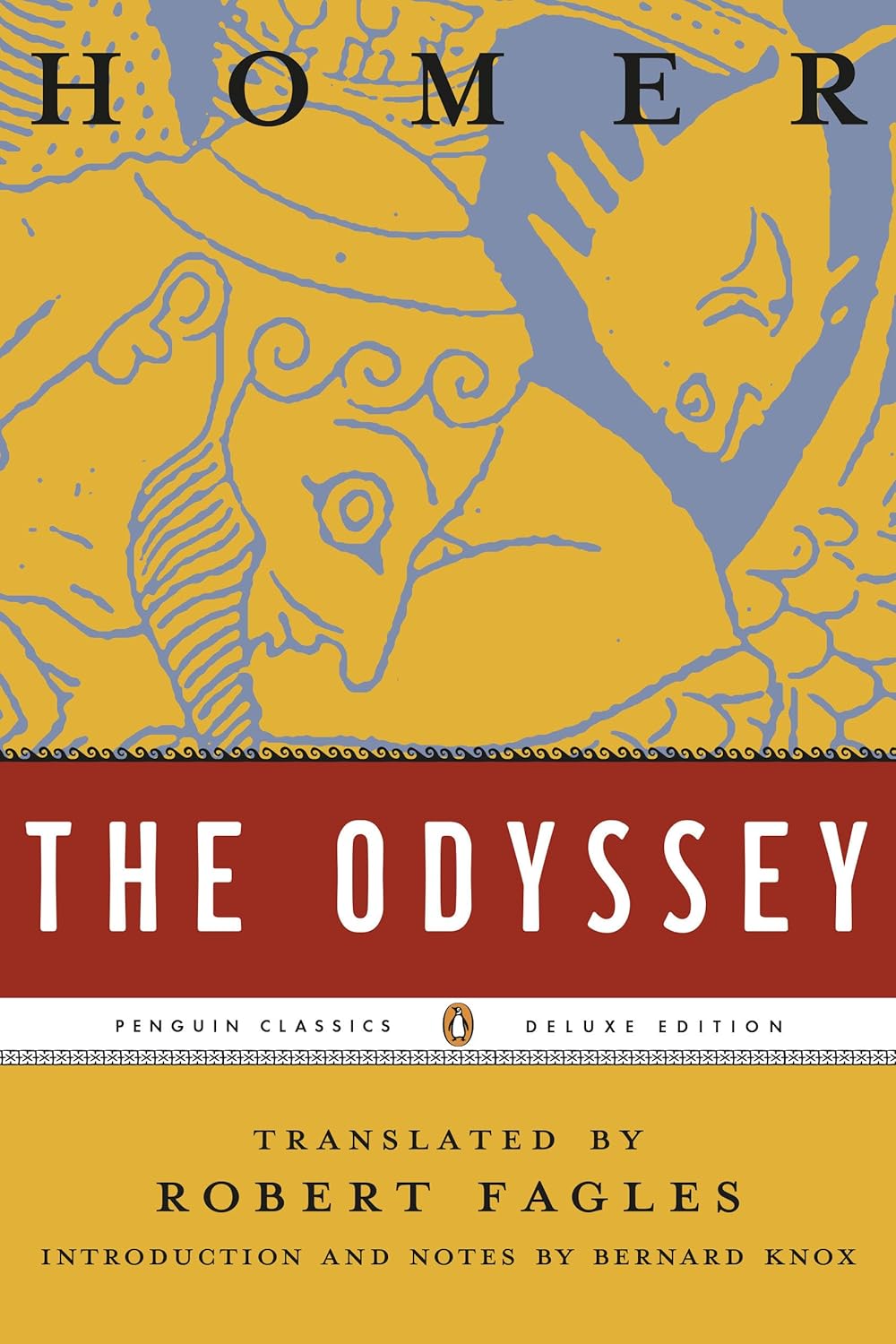
The Eternal Wanderer: Introduction
Few works in the Western literary canon command the monumental reverence bestowed upon The Odyssey by Homer. Written in the late 8th or early 7th century BCE, this foundational epic poem has survived millennia to become the ultimate blueprint for the classic hero’s journey. Where its companion piece, The Iliad, captures the brutal, static claustrophobia of the Trojan War, The Odyssey breaks free into the vast, unpredictable horizon of the Mediterranean sea. It serves as the spiritual ancestor to everything from James Joyce’s Ulysses to modern cinematic space operas, remaining a gripping exploration of survival, identity, and the irrepressible human longing for home.
Ithaca’s Lost King: Key Details
| Book Title | Genre | Target Audience | Anwar Library Rating |
|---|---|---|---|
| The Odyssey | Epic Poetry / Classical Mythology | Lovers of mythology, literary classics, and heroic adventures | 5.0 / 5.0 |
An Epic Masterpiece: Quick Verdict & Vibe
Homer’s masterpiece is an unmissable cornerstone of literature that remains astonishingly readable and psychologically complex despite its ancient origins. It brilliantly balances high-stakes mythical combat with deeply intimate domestic drama. While the non-linear structure and archaic pacing in certain catalogs might test modern readers, the payoff is an incomparable storytelling experience.
- Pros: Timeless psychological depth, unforgettable mythical monsters, and an ingenious non-linear narrative structure.
- Cons: Certain episodic passages and repetitive formulaic epithets can slow down the momentum for contemporary audiences.
The Wrath of Poseidon: Plot Summary (No Spoilers)
The narrative opens ten years after the fall of Troy, and a full twenty years since Odysseus, King of Ithaca, first left his shores to fight in the Trojan War. While other Greek heroes have either returned home or perished, Odysseus is trapped on the remote island of Ogygia, held captive by the beautiful nymph Calypso, who offers him immortality if he stays as her husband. Back home in Ithaca, his palace is besieged by a rowdy, destructive cohort of suitors who believe Odysseus is dead, all vying for the hand of his wife, Queen Penelope, and plotting to assassinate his young son, Telemachus.
The divine intervention of Athena shifts the tides of fate. Securing permission from Zeus, she prompts Telemachus to sail in search of news regarding his father, while Hermes orders Calypso to release her captive. Odysseus constructs a makeshift raft, only to face the devastating fury of the sea god Poseidon, who harbors a deep-seated grievance against the hero. Stranded on the island of the Phaeacians, an exhausted Odysseus recounts his fantastic, terrifying trials over the past decade—including encounters with the lotus-eaters, the monstrous Cyclops Polyphemus, the sorceress Circe, the perilous Sirens, and a harrowing descent into the Underworld—setting the stage for a desperate attempt to reclaim his throne.
The Slaughter in the Great Hall: Ending Explained & Plot Twists (Spoilers)
Click to expand the deep-dive spoiler zone
🚨 WARNING: Major Spoilers Ahead! Do not expand this section unless you have finished the book.
The climax of The Odyssey centers on Odysseus’s highly calculated, brutal return to Ithaca. Disguised as a ragged beggar by Athena to test the loyalty of his household, Odysseus witnesses firsthand the insolence of the suitors. Penelope, pushed to her absolute limit, announces an impossible contest: she will marry whoever can string Odysseus’s massive hunting bow and shoot an arrow cleanly through the rings of twelve aligned axe heads. While every suitor fails miserably, the disguised Odysseus steps forward, strings the bow effortlessly, and executes the shot.
What follows is a meticulously orchestrated bloodbath. Revealing his true identity, Odysseus, alongside Telemachus and two loyal servants, locks the doors of the great hall and systematically executes all 108 suitors, showing absolutely no mercy to those who defiled his home. Penelope, ever cautious, subjects Odysseus to a final test of identity by ordering their bridal bed to be moved—a trick, as Odysseus famously built the bed out of a living olive tree rooted to the earth, making it unmovable. Recognizing his fury, Penelope finally embraces her long-lost husband. The epic concludes as Athena steps in to broker a divine peace pact between Odysseus and the vengeful families of the slain suitors, restoring absolute sovereignty to Ithaca.
Lyricism Versus Grit: Critical Assessment of the Novel
The “Real Talk”: Pacing, Prose, and Impact
Reading The Odyssey requires adjusting one’s internal clock to the oral traditions of ancient Greece. The use of formulaic repetitions and dactylic hexameter meter—brilliantly captured in modern translations like those by Robert Fagles or Emily Wilson—creates a rhythmic, mesmerizing experience. The prose possesses a raw, visceral grit during combat scenes, contrasted sharply by the lyrical elegance of its descriptions of nature and the cosmos. The narrative pacing is beautifully fragmented; by starting *in media res* (in the middle of things), Homer crafts a multi-layered mystery that maintains suspense across twenty-four distinct books.
The Mind of Many Turns: In-Depth Character Analysis
Odysseus stands out among ancient mythological figures because his defining trait is not brute strength, but *metis*—cunning intelligence and resourcefulness. He is an layered, deeply flawed protagonist; his hubris (excessive pride) in taunting the Cyclops draws the curse of Poseidon, prolonging his torment. Yet, his capacity for endurance is unmatched. Alongside him is Penelope, who matches his sharp intellect step-for-step, utilizing her own cunning tactics—like weaving and unweaving Laertes’ shroud—to hold off political ruin. Telemachus provides a compelling coming-of-age arc, transforming from a passive, grieving boy into a confident prince worthy of his father’s fierce legacy.
Atmospheric Chemistry: Vibe Check
Oceanic: The omnipresent, salt-crusted, unpredictable sea serves as both a literal setting and an unstable psychological landscape.
Melancholic: A profound sense of loss, aging, and nostalgia flows underneath the high-stakes action sequences.
Vengeful: The sharp, unforgiving edge of divine anger and violent justice dominates the second half of the epic.
Hospitality and Divine Retribution: Themes & Motifs Deep Dive
The architectural foundation of The Odyssey relies heavily on the concept of *Xenia*—the ancient Greek sacred law of guest-host hospitality. Every location Odysseus visits serves as a test of this virtue; civilized worlds welcome strangers with food and safety, whereas monstrous realms, like that of the Cyclops, violate *Xenia* by devouring their guests. The suitors’ fatal flaw is their gross exploitation of Penelope’s hospitality, making their eventual slaughter an act of divine justice. Furthermore, the poem is a profound meditation on memory and identity; to return home (*nostos*), Odysseus must constantly reject temptation and avoid forgetting who he truly is.
A Journey for the Curious Soul: Target Audience Guide
This epic poem is tailor-made for readers who appreciate complex character studies, historical world-building, and intricate narrative frameworks. If you love tracking the roots of modern storytelling tropes, or enjoy fantasy novels that deal heavily with divine pantheons and monsters, The Odyssey is an absolutely essential addition to your personal library bookshelf.
If You Loved This Drama: Similar Recommendations
The Iliad by Homer: The logical sister epic, offering a much darker, war-torn, action-packed exploration of rage and honor on the battlefields of Troy.
Circe by Madeline Miller: A brilliant, modern feminist reimagining that shifts the perspective to the enchanting sorceress, reframing Odysseus’s journey through her eyes.
The Aeneid by Virgil: The Roman answer to Homer, following Aeneas as he flees the ruins of Troy to fulfill his grand destiny of founding Rome.
Three Millennia of Echoes: Cultural Impact and Reader Reactions
For centuries, The Odyssey has sparked endless debate across literary circles and academic picking lists. On modern platforms like BookTok and Goodreads, the text continues to trend, driven heavily by a renaissance of classical mythological adaptations. Readers frequently discuss the moral ambiguity of Odysseus’s actions, debating whether his brutal vengeance against the suitors is justified, while celebrating Penelope as one of the most resilient, intelligent heroines in early literary history.
About the Author: Homer
Homer is the legendary, enigmatic figure credited by the ancient Greeks with composing both The Iliad and The Odyssey. While history knows little of his life—with tradition painting him as a blind bard from Ionia—modern scholarly consensus suggests these epics were the culmination of a long, collaborative oral tradition. His structural innovations and deep psychological insights shaped classical antiquity, fundamentally defining the trajectory of Western storytelling.
Frequently Asked Questions (FAQ)
What is the main message of The Odyssey?
The core message centers on the triumph of intelligence and mental endurance over raw physical power, alongside the deep spiritual importance of loyalty, family, and home (*nostos*).
How long did it take Odysseus to get home?
It took Odysseus ten full years to return home to Ithaca after the conclusion of the ten-year Trojan War, making his total time away from home twenty years.
Why did Poseidon hate Odysseus so much?
Poseidon sought vengeance against Odysseus because the hero blinded his son, the Cyclops Polyphemus, and boastfully revealed his true identity out of pride.
Where to Buy & Read
Ready to immerse yourself in this unputdownable book? Use the verified, functional search retail links below to find the best deals on physical, digital, or audio editions: