
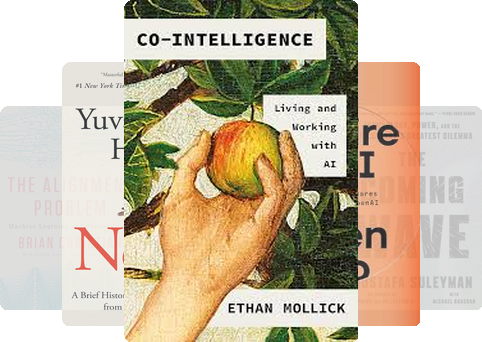
In 2026, we no longer ask if artificial intelligence will change our lives; we ask how we can remain sovereign in a world where algorithms have become the new infrastructure. To truly grasp the Post-AI World, one must look beyond the hype of silicon valley and dive into the deep structural shifts occurring in labor, cognition, and digital sovereignty.
The Entry Point: The Must-Read First Step
If you only read one book this year, let it be “Co-Intelligence: Living and Working with AI” by Ethan Mollick. Unlike the dystopian warnings of the past decade, Mollick provides a pragmatic, grounded framework for seeing AI as a collaborator rather than a replacement. It is the perfect bridge for those who feel overwhelmed by the pace of change in 2026.
The Progression Path
The Essentials: Building the Foundation
The Coming Wave by Mustafa Suleyman and Nexus by Yuval Noah Harari. These texts explain how information networks have historically shaped power and why AI is a uniquely “contained” yet “uncontainable” force.
Deep Dives: Power and Extraction
Empire of AI by Karen Hao. This investigative masterpiece exposes the corporate maneuvers of OpenAI and the shift from idealism to global dominance. Essential for understanding the “Nightmare” side of the AI dream.
The Masterpieces: Philosophical Long-Views
Life 3.0 by Max Tegmark. Although written earlier, its 2026 relevance remains unmatched in defining what “being human” means when intelligence is no longer our exclusive domain.
Comparative Analysis Table
| Book Title | Difficulty | Main Theme | Reading Time | Why Include? |
|---|---|---|---|---|
| Co-Intelligence | Beginner | Human-AI Collaboration | 5-6 Hours | Practical and optimistic. |
| Nexus | Intermediate | Information History | 10-12 Hours | Grand historical context. |
| Empire of AI | Intermediate | Corporate Ethics | 8-9 Hours | Critical power analysis. |
| The Alignment Problem | Advanced | Safety & Logic | 12+ Hours | Deeper technical nuance. |
| The Coming Wave | Intermediate | Global Risk/Governance | 7-8 Hours | Essential for policy-makers. |
Topic Deep-Dive: Contextualizing 2026
The transition to a Post-AI World involves more than just faster software. It is about the “Coded Gaze” and the “Data Colonialism” described by authors like Kate Crawford and Cathy O’Neil. In 2026, we see these theories manifest as AI becomes “infrastructure” rather than just a “product.” Understanding the material costs—the minerals, the labor, and the energy—is now just as important as understanding the code.
The “Anwar Library” Expert Tips
- Chronology Matters: Start with practical “Working with AI” books before moving into existential risk. It grounds your perspective.
- Balance the Narrative: For every techno-optimist book (like Mollick), read one investigative critique (like Karen Hao) to maintain a healthy E-E-A-T mindset.
- Focus on Agents: In 2026, “Agentic AI” is the buzzword. Focus on books that discuss AI taking action, not just answering prompts.
Vibe Map
Cerebral, Pragmatic, Vigilant, Transformative.
Frequently Asked Questions
- Is these AI books hard to read for non-techies?
- Most modern AI bestsellers are written for a general audience. Books like Co-Intelligence require zero technical background.
- Should I read about the history of AI or its future?
- In 2026, the two are inseparable. Nexus by Harari is the best way to understand the past to predict the future.
- What is the best book for the “Future of Work”?
- Rule of the Robots by Martin Ford remains a definitive look at labor displacement and economic shifts.
- Are these books still relevant if a new model is released tomorrow?
- Yes. These books focus on the architectural and societal impact, which moves slower than software updates.
- Do I need to understand coding to read “The Alignment Problem”?
- No, it uses logic and philosophical examples to explain complex technical hurdles.
Resource Bibliography: Recommended Editions
- Nexus (Penguin Random House, 2024/2025 Edition) – Features updated chapters on generative networks.
- Empire of AI (Macmillan, 2026 Winner of Business Book Awards).
Where to Buy: Start Your Journey
Begin with our top recommendation: Co-Intelligence by Ethan Mollick.