
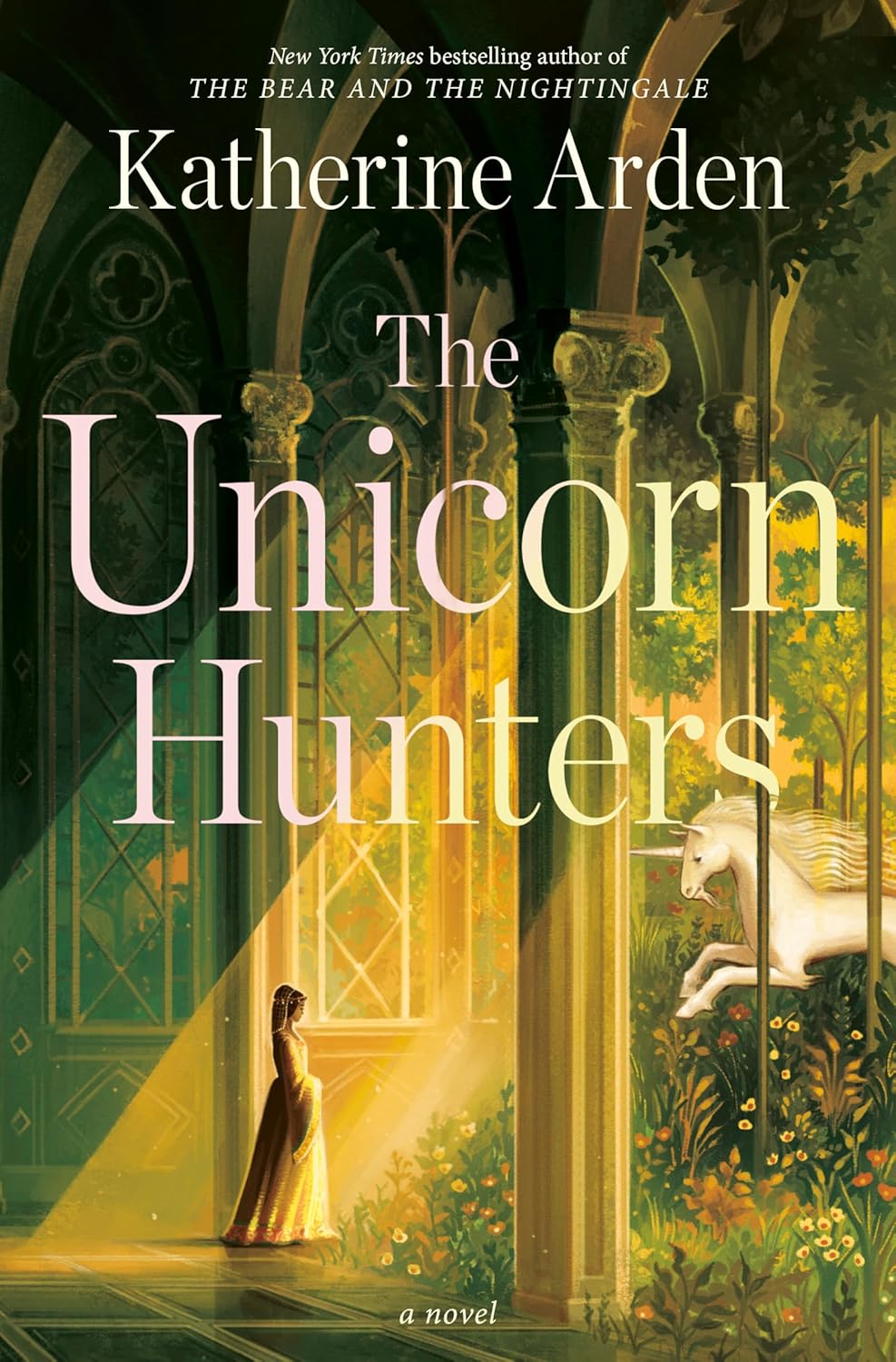
Frozen Landscapes and Primeval Dread: Introduction
When readers first crossed the threshold into the frost-rimed world of Katherine Arden’s celebrated Winternight Trilogy, they discovered an author capable of transmuting traditional folklore into absolute, bone-chilling literary magic. Standing as a bold, transgressive evolution of her signature style, The Unicorn Hunters by Katherine Arden systematically dismantles one of the most sanitized creatures in Western mythology. Instead of a sparkling symbol of purity, Arden resurrects the unicorn as an ancient, apex predator—a violent force of nature that exacts a bloody toll on those foolish enough to seek its power. This narrative operates like a grim, folk-horror survival epic wrapped in the exquisite, lyrical prose of a timeless fairy tale, drawing stylistic parallels to grim-dark milestones and primeval gothic thrillers where the wilderness itself functions as an unyielding antagonist.
The Unicorn Hunters At a Glance: Key Details
| Book Title | Genre | Target Audience | Anwar Library Rating |
|---|---|---|---|
| The Unicorn Hunters | Dark Fantasy / Gothic Horror | Enthusiasts of dark folklore, wilderness survival stories, and subversive mythological fiction | 4.9 / 5.0 |
A Sanctuary Painted in Bone and Silver: Plot Summary of The Unicorn Hunters (No Spoilers)
The operational framework of The Unicorn Hunters introduces readers to a hardscrabble, isolated settlement perched at the edge of an ancient, uncharted northern taiga. The community survives on the margins of a changing empire, bound by strict ancestral taboos regarding the deep woods. For generations, the village has maintained a fragile truce with the entities residing beneath the canopy, recognizing that the forest is governed by primeval laws far older than human civilization. However, this delicate equilibrium is completely shattered when an aristocratic hunting expedition arrives from the capital, armed with advanced weaponry and driven by an insatiable, colonial desire to capture the ultimate mythological prize: a silver-horned beast whose blood is rumored to grant eternal life.
As the predatory expedition forces the local trackers to guide them into the frozen interior, the narrative engine rapidly accelerates. The hunt transforms almost immediately into a frantic, claustrophobic nightmare as the party realizes they have not invaded the territory of a passive herbivore, but the hunting grounds of a bloodthirsty celestial entity. The weather turns into a violent weapon, burying their escape routes under feet of ice, while a shifting, invisible terror systematically picks off the hunters one by one. Arden masterfully builds a thick, suffocating sense of paranoia line by line, leaving casual pre-readers stranded in the freezing dark just as the line between the hunters and the hunted is completely erased.
The Altar of the Blood-Stained Horn: The Unicorn Hunters Ending Explained & Plot Twists (Spoilers)
Click to expand the deep-dive spoiler zone
🚨 WARNING: Major Spoilers Ahead! Do not open this section unless you have completely finished reading the book or actively seek full structural breakdowns of the climax.
The final act of The Unicorn Hunters delivers an incredibly dark, subversive twist that redefines the true nature of the monstrous entities in the forest. The climax reveals that the main stallion the expedition was hunting is actually an ancient guardian bound to the land itself; its predatory violence was a defensive mechanism triggered to keep a catastrophic, subterranean rot from escaping the forest boundaries. The tragic twist reveals that the village elder had struck a secret deal with the capital’s aristocrats, sacrificing the tracking party in exchange for imperial funds to relocate the village before the winter froze them out completely.
In a blood-drenched, harrowing final confrontation set within a sacred, moonlit clearing surrounded by frozen waterfalls, the heroine turns her blade against the remaining imperial commanders. Realizing that the wounded stallion’s death would break the ancient ward keeping the true subterranean horrors contained, she forms a visceral, telepathic blood-bond with the beast. Together, they execute the imperial hunters in a cinematic sequence of poetic, violent retribution. The epilogue skips forward to the arrival of spring, showing the heroine completely transformed into the new immortal guardian of the woods, living isolated in the taiga alongside the herd, ensuring that human greed never crosses the tree line again.
Lyrical Poetry vs. Uncompromising Brutality: Critical Assessment of the Novel
The “Real Talk”: Pacing, Prose, and Impact
Katherine Arden’s literary prose operates with the dazzling, deceptive beauty of fresh snowfall covering a bear trap. What sets this book entirely apart in contemporary dark fantasy is her willingness to match gorgeous, rhythmic sentence structures with uncompromising, stomach-churning body horror. Arden writes about frozen flesh, splintered bone, and ancient terrors with an almost religious reverence, ensuring that the horror feels sacred rather than cheap. The pacing is a masterclass in slow-burn tension; she allows the freezing cold and the psychological unraveling of the hunting party to simmer for the first half of the book before unleashing a relentless, fast-paced avalanche of violence in the final third.
If there is a minor point of criticism, it lies in the structural adherence to traditional folk-horror archetypes. The arrogant city dwellers who refuse to respect local lore behave with a predictable stubbornness that occasionally makes their individual demises feel like ticking off a genre checklist. However, Arden completely compensates for this by infusing the local guides and the forest’s ecology with such profound depth and nuance that the familiar narrative tracks feel completely re-energized, delivering an emotional payoff that is both devastating and wildly triumphant.
Ancestral Instincts and Fractured Sanity: In-Depth Character Analysis
The psychological depth of the central characters elevates The Unicorn Hunters from a simple monster movie in print into a compelling exploration of human resilience. The heroine is a beautifully realized protagonist—a young woman trapped between her reverence for ancestral traditions and a burning, individualistic desire to escape the crushing domestic expectations of her village. Her evolution throughout the frozen expedition is radical; she transforms from a reluctant guide into a fierce, predatory entity in her own right, shedding her civilized constraints to survive the unyielding environment.
The lead imperial antagonist provides a chilling, intellectual counterweight. Crafted as a hyper-rational product of the Enlightenment, he views the magical forest not with holy awe, but as a collection of resources waiting to be mapped, categorized, and commodified. His descent into obsession and eventual madness as his scientific worldview fails to account for the supernatural terrors around him provides a brilliant, tragic arc. The psychological warfare between his rigid logic and the heroine’s instinctual understanding of the woods forms the true emotional spine of the narrative.
Atmospheric Chemistry: Vibe Check
To fully grasp the aesthetic and emotional texture of this dark fairy tale before venturing into the woods, let us run an atmospheric vibe check:
- Incandescent: The magic of the unicorns glows with a sharp, blinding silver light that pierces the perpetual twilight of the northern forest.
- Claustrophobic: Despite the vastness of the northern wilderness, the towering pines and encroaching blizzards create a suffocating sense of entrapment.
- Visceral: The survival elements are depicted with raw, unyielding realism—from the agony of frostbite to the terrifying physical power of the beasts.
- Eerie: A heavy, ancient silence hangs over the prose, broken only by the unnatural snapping of frozen branches and the breathing of unseen predators.
Colonial Hubris and Ecological Retribution: Themes & Motifs Deep Dive
At its philosophical core, The Unicorn Hunters functions as a scathing critique of colonial hubris and the industrial commodification of nature. Arden uses the imperial expedition to demonstrate how modern empires attempt to violently tame and monetize ancient ecosystems, completely blind to the catastrophic ecological consequences of their greed. The unicorn’s horn represents not a prize to be won, but the dangerous hubris of humanity believing it can possess and exploit the sacred components of the natural world without inviting total destruction.
Another dominant theme is the reclamation of transgressive feminine power. The heroine spends her life being told to quiet her wild instincts to fit into a dying societal structure. The text continually proves that her survival—and her ultimate salvation—is entirely dependent on her rejecting civilization altogether and embracing her wild, primal nature. The recurring motifs of pristine white snow turning crimson, the cold light of the moon, and the breaking of iron tools serve to visually reinforce this internal transition from submissive containment to untamed, sovereign power.
When the Wild Call Resonates: Target Audience Guide
This book is engineered specifically for readers who want their high-fantasy novels mixed with a heavy dose of folk-horror and wilderness survival. If your literary tastes lean toward the rich, dark folklore of authors like Naomi Novik, Ava Reid, or the atmospheric horror of Brom, Arden’s precise blend of beauty and terror will captivate you instantly. It is ideal for readers who are exhausted by sanitized, glittering fairy tales and wish to explore the ancient, dangerous roots of mythological storytelling where monsters and gods are completely indistinguishable.
If You Loved This Drama: Similar Recommendations
If the final pages of this northern nightmare have left a void on your reading list, consider immersing your senses in these highly compatible titles:
- Uprooted by Naomi Novik: A modern dark fantasy classic featuring a corrupt, predatory forest that requires a high emotional and physical sacrifice from those living on its borders.
- The Wolf and the Woodsman by Ava Reid: A fierce, culturally rich dark fantasy that explores religious tension, mythic monsters, and an uneasy alliance forged in a brutal, frozen landscape.
- The Ritual by Adam Nevill: For readers who want to strip away the fantasy elements and lean fully into the terrifying, claustrophobic folk-horror of a group of hikers being hunted through an ancient Nordic forest.
Folk-Horror Hype and Critical Acclaim: Cultural Impact and Reader Reactions
The digital literary community has responded to The Unicorn Hunters with immense critical enthusiasm. Across major platforms like BookTok, Instagram, and Goodreads, the novel has consistently trended as a triumphant return to form for Arden. Readers heavily praise her for completely subverting a tired fantasy trope and restoring an element of real danger and majesty to mythological creatures that had been over-commercialized by modern culture.
Independent book clubs and major speculative fiction picking lists have singled out the novel for its exceptional atmospheric world-building and its sharp environmental commentary. Reviewers consistently note that Arden’s writing possesses the rare ability to make the reader feel physically cold while reading, securing the book’s position on numerous “Best Dark Fantasy of the Year” lists and cementing her reputation as an absolute master of modern folklore reinvention.
About the Author: Katherine Arden
Katherine Arden is an exceptionally accomplished American author best known for her critically acclaimed Winternight Trilogy, which established her as a dominant voice in historical fantasy and folklore reimagining. Armed with a degree in Russian and French from the University of Texas at Austin, Arden lived in Moscow and Hawaii before turning to fiction full-time. Her deep, academic knowledge of historical linguistics, folklore structures, and northern landscapes enriches her meticulous world-building and sharp pacing, earning her Hugo and Nebula award nominations and a fiercely loyal global readership.
Frequently Asked Questions (FAQ)
Q: Is The Unicorn Hunters connected to the Winternight Trilogy?
A: No. While it shares a similar cold, atmospheric setting and draws on dark folklore elements, it is an entirely independent standalone novel featuring a brand-new mythos, setting, and character cast.
Q: What is the explicit content rating and violence level for this book?
A: The book features low romance/spice elements but contains a very high level of visceral, descriptive violence and body horror that is deeply integrated into the survival and folk-horror aspects of the plot.
Q: Does the story feature a traditional happy ending?
A: No. The novel concludes with a dark, bittersweet, and mythic ending that provides complete narrative resolution and a satisfying happily-ever-after for the heroine’s autonomy, though it rejects standard domestic conventions.
Where to Buy & Read
Ready to immerse yourself in this unputdownable book? Use the verified, functional search retail links below to find the best deals on physical, digital, or audio editions: