
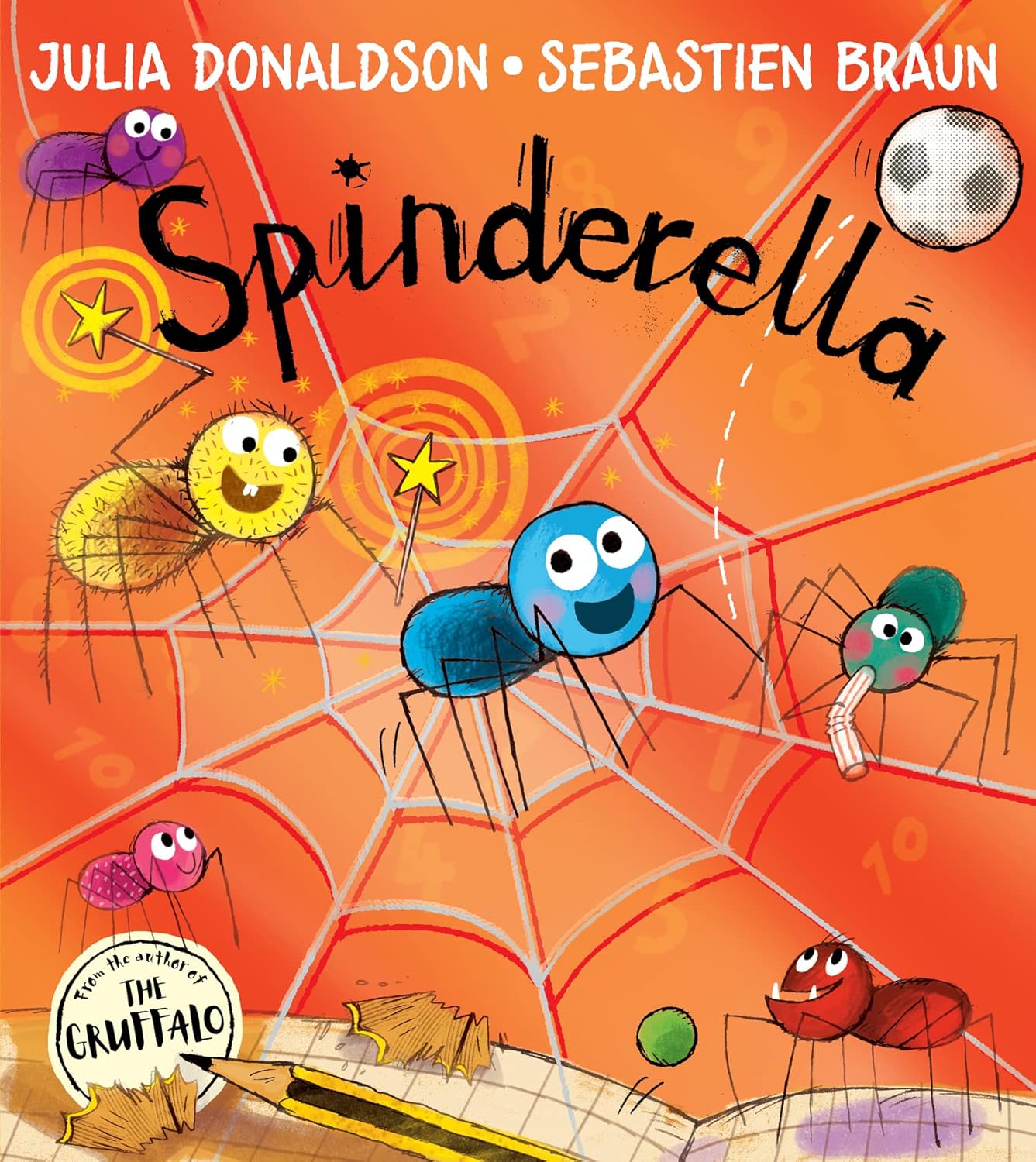
Arachnid Arithmetic: Introduction
In the expansive landscape of contemporary children’s picture books, few partnerships evoke as much natural excitement as a narrative engineered by the iconic storyteller Julia Donaldson. With Spinderella, originally published in collaboration with the highly celebrated illustrator Liz Pichon, Donaldson spins an enchanting, pedagogical yarn that fundamentally subverts the traditional “creepy-crawly” trope. Much like cultural benchmarks such as Charlotte’s Web or Donaldson’s own landmark classic The Gruffalo, this text relies heavily on a deeply charming protagonist who must navigate structural, societal constraints using raw intellect rather than physical imposition. It transforms the inherently intimidating geometry of a spider’s web into a playground for early childhood mathematics, making it an essential case study for modern literary analysis.
The Counting Web: Key Details
| Book Title | Genre | Target Audience | Anwar Library Rating |
|---|---|---|---|
| Spinderella | Children’s Educational Fiction | Early Readers, Parents, and Primary Educators (Ages 4–7) | 4.8 / 5.0 |
The Critic’s Lens: Quick Verdict & Vibe
Spinderella is a brilliant educational framework disguised as an whimsical children’s adventure. It masterfully bridges the gap between early literacy and basic numeracy, providing educators and parents with an organic tool to introduce counting, sorting, and structural division without compromising on rhythmic entertainment.
- Pros: Exceptional integration of early mathematical concepts; vibrant, high-energy illustrations by Liz Pichon; highly memorable rhythmic cadences typical of Donaldson’s storytelling style.
- Cons: The resolution relies heavily on a deus ex machina mechanism via a fairy godmother character, which slightly undercuts the protagonist’s independent problem-solving path.
The Quest for Numbers: Plot Summary (No Spoilers)
The story introduces us to Spinderella, a humble, enthusiastic young spider who resides in a bustling school classroom. While her extensive family—consisting of her mother and dozens of brothers and sisters—is completely preoccupied with the pragmatic art of catching flies and spinning standard architectural webs, Spinderella harbors a singular, intense passion: a burning desire to learn how to count. Her family flatly rejects her numerical aspirations, considering counting to be a completely useless endeavor for an insect whose primary evolutionary directive is survival and web construction.
Spinderella’s worldview is fundamentally altered as she observes the human children in the classroom below. She watches them interact with numbers, play structured sports, and count objects sequentially. Driven by an insatiable curiosity, she attempts to introduce these revolutionary concepts to her family, only to cause massive logistical confusion. Without a formal grasp of numbers, her family cannot agree on how many flies to catch, how to divide their food equitably, or how many legs they actually possess, establishing a profound communicative divide within the web.
The Hairy Godmother’s Intervention: Ending Explained & Plot Twists (Spoilers)
Click to expand the deep-dive spoiler zone
🚨 WARNING: Major Spoilers Ahead! Do not expand this section unless you have finished reading the book.
Frustrated by her family’s complete inability to comprehend the systemic utility of numbers, Spinderella is suddenly visited by her “Hairy Godmother”—a direct, brilliant play on the traditional fairy godmother archetype. This magical arachnid entity recognizes Spinderella’s academic potential and uses her mystical wand to transport Spinderella directly down to the classroom floor when the school is empty.
Through this magical guidance, Spinderella undergoes an accelerated learning journey, mastering numbers from one all the way to twenty. Equipped with this precise new vocabulary, she returns to her web in the ceiling rafters. She immediately applies her new knowledge to resolve her family’s structural problems: she counts their accumulated flies to ensure perfect democratic division, and she systematically organizes a highly competitive, functional game of spider football using a small green button as a ball.
The final narrative twist highlights the ultimate utility of mathematics: when her mother mistakenly tries to divide the football teams, Spinderella correctly points out that since spiders have eight legs, they need exactly two teams of four spiders each to ensure absolute athletic equity. Her family finally recognizes the immense value of numeracy, crowning Spinderella as the undisputed champion of the web.
Pedagogical Prose vs. Whimsical Art: Critical Assessment of the Novel
The “Real Talk”: Pacing, Prose, and Impact
From a technical standpoint, the structural pacing of Spinderella is incredibly precise, tailored beautifully to the developmental milestones of early readers. Donaldson deliberately moves away from her signature overarching rhyming couplets for the primary prose, utilizing clean, rhythmic conversational dialogue that emphasizes mathematical progression instead. This stylistic shift allows the numerical concepts to stand at the forefront of the text without being obscured by complex structural meter.
The emotional resonance of the story is powered primarily by Liz Pichon’s artistic contributions. Pichon’s visual style features thick, friendly outlines, bright neon color palettes, and exceptionally expressive eyes on the arachnid characters. This specific aesthetic approach plays an important psychological role: it completely neutralizes the widespread arachnophobia that many young readers naturally experience, transforming potentially frightening insects into friendly, accessible, and deeply expressive peers.
The Academic Arachnid: In-Depth Character Analysis
The narrative relies on a concise but deeply effective cast of characters to drive its educational theme home:
- Spinderella: The ultimate surrogate for the young student. Her character arc represents academic curiosity standing firm against familial tradition and anti-intellectual skepticism. Her resilience makes her an excellent role model for early learning mindsets.
- The Mother Spider: Represents traditionalism and the pragmatic survival instinct. Her initial dismissal of counting reflects the real-world frustration children experience when adults fail to see the immediate value in their creative or academic observations.
- The Hairy Godmother: A manifestation of institutional mentorship. She represents the ideal educator who steps in with the right resources, providing a safe, accelerated space for a passionate student to thrive.
Atmospheric Chemistry: Vibe Check
To accurately understand the experiential nature of reading this book, we can break down its core aesthetic chemistry:
Exuberant: The visual landscape is bursting with bright colors, energetic patterns, and playful page layouts that keep young eyes constantly moving.
Empowering: The text deliberately frames academic mastery—specifically learning mathematics—as a legitimate superpower that can bring order to structural chaos.
Whimsical: From spider football games to magical wands, the book balances real-world classroom math with pure, joyful fantasy elements.
Numeracy as Liberation: Themes & Motifs Deep Dive
The core thematic architecture of Spinderella centers on the idea of Numeracy as an Instrument of Social Order. Before Spinderella introduces counting to her family, their existence is chaotic: food division is highly unequal, activities lack organization, and communication is completely vague. By introducing precise mathematical units, Spinderella doesn’t just learn a new skill; she introduces structural fairness, democratic harmony, and systematic recreation to her entire society.
Additionally, the book handles the motif of The Classroom Visual Divide beautifully. The physical separation between the human children on the classroom floor and the spider web up in the ceiling rafters represents the classic cognitive barrier between unorganized intuition and structured education. Spinderella crossing that physical barrier to learn on the floor symbolizes a child’s exciting transition into formal, systemic education.
The Ideal Classroom Companion: Target Audience Guide
This book is highly recommended for specific reading environments:
- Preschool & Kindergarten Educators: A flawless tool for introducing lesson plans focused on basic counting, group division, and the concept of pairs.
- Parents Navigating Math Anxiety: Perfect for children who show early hesitation towards numerical concepts, framing mathematics as a fun, practical game.
- Fans of High-Energy Illustration: A must-have for admirers of Liz Pichon’s distinct artistic work, particularly those who love her famous Tom Gates series.
If You Loved This Drama: Similar Recommendations
If the unique mathematical and narrative dynamics of this book resonated with you, consider exploring these titles next:
- What Planet Are You From, Clarice Bean? by Lauren Child: Offers a similarly quirky, highly stylistic visual layout that tackles academic and environmental themes through a child’s unique perspective.
- The Smeds and the Smoos by Julia Donaldson: If you love Donaldson’s ability to take complex social dynamics (like division and community integration) and distill them into highly accessible stories for young children.
- Peg + Cat: The Sword in the Stone by Jennifer Oxley: A fantastic alternative that uses an adventurous narrative to teach specific primary math concepts like shapes and counting.
The Primary School Buzz: Cultural Impact and Reader Reactions
Within the wider children’s literary community, Spinderella has earned a very specific, lasting reputation as a premier “cross-curricular” text. On platforms like Goodreads and specialized educational forums, the book is consistently praised by primary school teachers for its incredible ability to engage children who love stories but traditionally struggle with math. It frequently appears on curated STEM (Science, Technology, Engineering, and Math) reading lists for early childhood development due to its highly successful fusion of storytelling and structural logic.
About the Author: Julia Donaldson
Julia Donaldson is widely considered one of the most successful, influential, and decorated children’s authors of the modern era. Serving as the UK Children’s Laureate from 2011 to 2013, her incredible body of work includes legendary masterpieces such as The Gruffalo, Room on the Broom, and Stick Man. Her unique professional background in songwriting and writing children’s television programming shines through in her masterfully structured text, ensuring her books remain endlessly engaging when read aloud in busy classrooms or cozy bedrooms alike.
Frequently Asked Questions (FAQ)
Q: What specific mathematical concepts does Spinderella teach?
A: The book introduces early readers to counting sequentially from 1 to 20, sorting objects into equal groups, matching pairs, and understanding the real-world utility of numbers in sports and food division.
Q: Is Spinderella written entirely in rhyme like The Gruffalo?
A: No. While it features the classic rhythmic momentum and playful refrains that Julia Donaldson is famous for, it utilizes a conversational prose format to ensure the mathematical concepts remain clear and easy to follow.
Q: What reading age group is this book best suited for?
A: It is ideal for children aged 4 to 7 years old, making it a perfect fit for preschool, kindergarten, and early first-grade reading levels.
Where to Buy & Read
Ready to immerse yourself in this unputdownable book? Use the verified, functional search retail links below to find the best deals on physical, digital, or audio editions: