
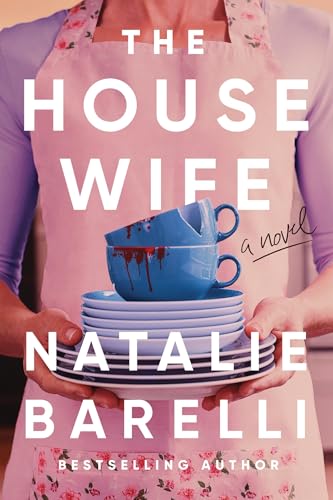
Polished Veneers and Poisoned Aprons: Introduction
The domestic thriller genre is packed to the gills with marriages gone wrong, but few writers slice through the pristine drywall of suburban bliss with the absolute, deadpan savagery of Natalie Barelli. In The Housewife, Barelli introduces us to a psychological ecosystem that feels instantly familiar yet terrifyingly distinct. If you have ever found comfort in the hyper-curated, clinical cleanliness of trending home-organization influencers, this book will ruin that peace forever. It takes the classic structural framework popularized by blockbusters like Gillian Flynn’s Gone Girl or Freida McFadden’s The Housemaid and distills it into a claustrophobic, high-society nightmare that subverts every cliché about submissive marital dynamics.
At its heart, The Housewife by Natalie Barelli functions as a psychological chess match where the board is an architectural masterpiece in Beverly Hills and the pieces are coated in chemical cleaning agents and deep-seated childhood trauma. Barelli strips away the warm, fuzzy illusions of the “tradwife” lifestyle to expose the transactional underbelly of high-society marriages. This is a novel that doesn’t just ask what secrets are hidden behind closed doors; it asks what happens when the person sweeping the floors has a mind far more dangerous than the monster holding the checkbook. Much like the underlying tension found in The First Time I Saw Him by Laura Dave, the initial romance serves as a deceptive mask for complex structural deceptions, though Barelli operates with a significantly darker, more cynical palette.
The Beverly Hills Blueprint: Key Details
| Book Title | Genre | Target Audience | Anwar Library Rating |
|---|---|---|---|
| The Housewife | Psychological Thriller / Domestic Noir | Fans of unreliable narrators and dark marital deceptions | 4.2 / 5.0 |
A Spotless Subversion: Quick Verdict & Vibe
Natalie Barelli delivers a blazing, deeply unhinged domestic thriller that uses short, addictive chapters to hook the reader by the throat. The book excels because of its incredibly sharp, darkly comedic narration, though it does occasionally stumble into a slightly rushed final act that packs a mountain of exposition into its concluding pages. If you appreciate plots wrapped in clinical gaslighting, it strikes a chord similar to You Deserve to Know, focusing heavily on what happens when the vulnerable stop being victims.
- Pros: A brilliantly unlikable, multi-layered protagonist; deadpan prose that shifts instantly from buttercream frosting to violent intent; incredible pacing that demands a single-sitting read.
- Cons: A few highly convenient plot resolutions in the final third; supporting characters that occasionally feel like static genre archetypes.
The Ghost of a Perfect Marriage: Plot Summary (No Spoilers)
Jodie has always possessed a singular, unwavering dream: she wanted to be a housewife. For her, the concept of domesticity isn’t an oppressive cage; it is a shield, a clean slate where her messy past can be scrubbed away until it bleeds. When she undergoes a whirlwind courtship with the wildly famous celebrity psychologist Dr. Roy Davies, she believes she has finally won the sociological lottery. She is moved into his staggering, clinical Beverly Hills mansion, given an endless budget for deep-cleaning supplies, and tasked with maintaining the flawless facade of a perfect wife.
However, the fairy tale curdles before the wedding cake is fully digested. Roy’s circle of elite, snobbish high-society friends treats Jodie like a low-class, gold-digging interloper who slid into Roy’s bed before the grief of his late wife, Deborah, had even cooled. To make matters worse, the house itself acts as a shrine to the deceased first Mrs. Davies. Deborah’s photographs still grace the walls, her high-end perfumes linger in the air vents, and the rigid housemaid, Marie, looks at Jodie with cold, undisguised contempt. Jodie is completely isolated, dismissed by everyone as an empty-headed trophy wife who is obsessed with spotless baseboards and preparing complex culinary dishes like Julia Child.
The true tension begins to tighten when Jodie uncovers disturbing fragments of Deborah’s final months. Before her tragic passing, the celebrated, beautiful Deborah had transformed into a complete recluse, hiding away from the world within the very walls Jodie now scrubs. As Jodie digs deeper into her husband’s highly polished public persona, she starts to see the cracks of an obsessive, hyper-controlling, and deeply unfaithful narcissist. She becomes increasingly convinced that Roy didn’t just break Deborah’s spirit—he may have orchestrated her demise. But turning to the police is out of the question. To expose Roy, Jodie would have to pull back the curtain on her own dark childhood and a catastrophic secret of her own. Trapped in a luxurious house built on quicksand and lies, Jodie must weaponize her invisibility before she vanishes just like the perfect wife before her.
The Blood on the Bleached Linoleum: Ending Explained & Plot Twists (Spoilers)
Click to expand the deep-dive spoiler zone
🚨 WARNING: Major Spoilers Ahead! Do not expand this section unless you have finished the book.
The explosive climax of The Housewife hinges on the ultimate weaponization of domestic invisibility. Throughout the novel, Dr. Roy Davies completely underestimates Jodie, viewing her obsessive deep-cleaning and submissive silence as proof of an easily manipulated mind. He treats her as a hollow vessel, unaware that her domestic precision is a direct survival mechanism forged during a brutal, violent childhood. Jodie’s dark secret is that she is no stranger to lethal self-defense; she has buried a past that taught her exactly how the world treats the vulnerable.
As Jodie accumulates irrefutable proof that Roy systemically gaslit and psychologically tortured Deborah to her death—utilizing his credentials as a psychologist to isolate her and label her insane—Roy realizes his new wife is getting too close to the truth. He attempts to turn his psychological toolkit on Jodie, enlisting the complicit housemaid, Marie, to spy on her, monitor her movements, and plant evidence to make Jodie look mentally unstable to his wealthy high-society peers.
The ultimate plot twist occurs when Jodie uses Roy’s own psychological trap against him. Instead of running or acting defensively, she leans entirely into her “crazy housewife” archetype. Leveraging her vast, terrifyingly clinical knowledge of chemical cleaning agents, she meticulously tracks the patterns of the household. She discovers that Roy has been having an affair and intends to dispose of her just as he did Deborah. In a breathless final confrontation, Jodie completely dismantles Roy’s pristine life. She reveals that she has been documenting every single instance of his control, his hidden financial fraud, and his medical malpractice.
With the help of minor, overlooked allies—including Dolores, the neighborhood housekeeper, and her deaf son, Mikey, whom Roy completely ignored—Jodie executes a flawless counter-frame. She ensures that Roy is caught red-handed in a trap of his own making, facing total social ruin, career destruction, and criminal prosecution for domestic abuse and murder. The novel wraps up with a whirlwind explanation showing that the spotless, buttercream-frosting-making housewife didn’t just survive the predator; she completely consumed his life, leaving the Beverly Hills house empty, clean, and entirely under her control. Roy is exposed as a monster, while Jodie walks away into a new life, proving that the most dangerous person in a mansion is the one who knows exactly how to clean up the blood.
Buttercream Frosting and Dinner Forks: Critical Assessment of the Novel
The “Real Talk”: Pacing, Prose, and Impact
What sets The Housewife completely apart from the standard domestic noir production line is the sheer brilliance of its narrative voice. Jodie is an absolute marvel of an unreliable narrator. Writing in a flat, deadpan, present-tense monologue, Barelli creates a chillingly hilarious juxtaposition between domestic perfection and homicidal ideation. In one paragraph, Jodie is casually detailing the exact method required to pick out linen drapes printed with delicate rose garlands or baking a flawless crème brûlée; in the very next sentence, she is calmly evaluating the structural damage she could inflict on a snobbish high-society guest with a standard dinner fork. This specific stylistic choice gives the book a distinct, razor-sharp edge that balances pitch-black humor with genuine psychological dread.
The pacing is fiercely propulsive, utilizing short, snappy chapters that practically force you to tell yourself “just one more page” until it is three in the morning. Barelli is a master at tightening the screws, dropping small, unsettling breadcrumbs about Roy’s toxic behavior and Jodie’s past with a rhythmic precision. Where the novel wobbles slightly is in its final sprint. After such an elegant, slow-burning buildup of psychological tension, the ending wraps up with a massive, Gilmore-Girls-speed rush of exposition. It is highly satisfying because every single thread is neatly tied and makes logical sense, but the sudden downpour of explanatory details feels somewhat congested compared to the immaculate pacing of the book’s first two-thirds.
The Unhinged Architect of Survival: In-Depth Character Analysis
Jodie stands out as one of the most compelling thriller protagonists of recent years because Barelli refuses to make her universally likable or morally pristine. She is deeply damaged, calculating, and cold, yet her voice is so intimate and her dark observations so witty that you cannot help but root for her. Her obsession with cleanliness is beautifully written not just as a quirky character trait, but as a direct psychological defense mechanism. For Jodie, dirt represents chaos, and chaos is where danger lives. By controlling every speck of dust in her physical space, she attempts to control the shifting, volatile threat of her marriage.
Dr. Roy Davies is a brilliantly realized villain because his malice isn’t cartoonish; it is systemic, quiet, and wrapped in professional authority. He represents the ultimate manifestation of patriarchal gaslighting, using his public standing as a celebrated mental health expert to invalidate his wives’ realities. The contrast between his public benevolence and his private cruelty makes the skin crawl. Meanwhile, the supporting characters like Marie provide an extra layer of chilling isolation, though it is the minor characters—Dolores and her son Mikey—who provide the book with its occasional, much-needed flashes of genuine human warmth and structural support for Jodie’s counter-offensive.
Five Brooms and a Bloody Knife: Atmospheric Chemistry: Vibe Check
The atmosphere of this novel is a highly volatile chemical reaction that can be summarized through a few distinct, potent dynamics:
- Clinical: The Beverly Hills mansion feels less like a home and more like a sterile, high-end operating room where identities are quietly dissected.
- Simmering: A constant, low-boil rage vibrates underneath every single polite interaction, dinner party, and casual conversation.
- Deadpan: The humor is incredibly dark, sliding effortlessly between domestic chores and survival instincts without ever winking at the audience.
- Claustrophobic: Despite the sprawling wealth and massive square footage of the estate, the narrative traps the reader entirely inside Jodie’s increasingly cornered mind.
The High-Society Trap of Perfect Domesticity: Themes & Motifs Deep Dive
Beneath its popcorn-thriller exterior, The Housewife executes a sharp, cutting critique of social class and the performance of gender roles. The book heavily interrogates the cultural obsession with the “perfect woman.” Roy doesn’t want a partner; he wants a curated piece of domestic infrastructure that reflects his own brilliance. Jodie’s performance of the submissive, cooking-obsessed housewife becomes a mirror that blinds him to her actual capabilities. Barelli highlights how high society uses politeness and etiquette as weapons to marginalize outsiders, showing that elite circles are often just highly polished arenas of emotional cruelty.
The prominent motif of cleaning products and immaculate surfaces serves as a brilliant metaphor throughout the text. Bleach, ammonia, and deep scrubbing aren’t just tools to remove physical stains; they represent the systemic erasure of history. Both Roy and Jodie are desperately trying to scrub away the past—Roy trying to wipe out the memory of what he did to Deborah, and Jodie trying to bleach away the scars of her childhood. The book repeatedly demonstrates that no matter how much chemical solution you pour onto a surface, the blood always finds a way to seep back through the floorboards.
For Fans of Domestic Deception: Target Audience Guide
This psychological thriller is tailormade for a very specific type of reader. If you are entirely exhausted by passive, helpless thriller protagonists who spend three hundred pages crying into a glass of wine while the villain terrifies them, Jodie will be an absolute breath of fresh air. It is a fantastic match for anyone who devours the work of Freida McFadden, B.A. Paris, or Samantha Downing. Reach for this book if you want a fast, voice-led domestic noir that you can easily demolish over a single weekend, and if you enjoy an unreliable narrator who can make you laugh and feel deeply unsettled within the exact same paragraph. However, if you require a universally likable lead with a pristine moral compass, or if themes of emotional abuse and gaslighting are difficult for you to read, you may want to skip this particular address.
Unsettling Marital Nightmares: If You Loved This Drama: Similar Recommendations
If the dark, domestic machinations of Natalie Barelli’s world left you craving more literary chaos, add these three highly acclaimed psychological thrillers to your reading list immediately:
- The Housemaid by Freida McFadden: This absolute juggernaut of a domestic thriller shares an identical energy, featuring a protagonist with a dark past who takes a domestic position inside a wealthy, beautiful home only to discover that the affluent couple behind the front door is hiding a deeply unhinged, dangerous reality.
- My Lovely Wife by Samantha Downing: For readers who fell completely in love with Jodie’s dark, deadpan, and morally grey inner monologue, Downing’s novel offers a pitch-black look at a modern marriage built on shared, incredibly dark secrets and a completely twisted take on domestic partnerships.
- Behind Closed Doors by B.A. Paris: If the terrifying, hyper-controlling psychological gaslighting of Dr. Roy Davies made your skin crawl, this classic domestic noir offers an incredibly intense, claustrophobic look at a seemingly perfect marriage that hides a horrific, locked-door struggle for survival.
The BookTok Infiltration of Domestic Thrills: Cultural Impact and Reader Reactions
Since its release by Poisoned Pen Press, The Housewife has swiftly ignited a massive wave of buzz across online reading communities, carving out a significant footprint on BookTok and Goodreads. Readers are heavily praising Barelli for her ability to inject a completely refreshing, wickedly sharp sense of humor into a genre that often takes itself far too seriously. The character of Jodie has sparked endless discussions, with influencers analyzing her bizarre cleaning monologues and celebrating her refusal to play the traditional, helpless victim.
While a small segment of genre purists have noted that the high-society setup and the predictable elements of the husband’s villainy feel familiar within the wider domestic noir landscape, the overwhelming public consensus focuses on the book’s incredible entertainment value. It is widely heralded as the ultimate “popcorn thriller”—an addictive, intensely fun, and breathless ride that rewards readers with a highly satisfying, completely earned sense of domestic justice.
The Master of Unreliable Matriarchs: About the Author: Natalie Barelli
Natalie Barelli is an internationally bestselling indie and traditional thriller author who has earned a fierce, dedicated global following for her remarkably sharp, voice-driven psychological suspense novels. Known for her ability to craft complex, deeply flawed, and endlessly fascinating female protagonists, Barelli has consistently mastered the art of the domestic twist. Her extensive and highly celebrated backlist includes standout thriller titles such as Until I Met Her, The Loyal Wife, The Housekeeper, Missing Molly, and The Accident. With a signature style defined by short chapters, dark humor, and razor-sharp pacing, Barelli continues to be a dominant, leading voice for readers seeking smart, fast-paced domestic noir.
Burning Reader Inquiries: Frequently Asked Questions (FAQ)
Is The Housewife by Natalie Barelli a standalone novel?
Yes, The Housewife functions entirely as a standalone psychological thriller. It features a complete, self-contained story that resolves all of its central mysteries and character arcs by the final page.
What are the main trigger warnings for The Housewife?
The novel contains prominent themes of severe psychological abuse, intense gaslighting, domestic control, mentions of a brutal and abusive childhood, and domestic violence. Reader discretion is advised for those sensitive to marital manipulation.
How long is the book, and who published it?
The novel is approximately 368 pages long and is officially published by Poisoned Pen Press, hitting shelves with widespread acclaim as a top summer thriller choice.
Securing Your Copy: Where to Buy & Read
Ready to immerse yourself in this unputdownable book? Use the verified, functional search retail links below to find the best deals on physical, digital, or audio editions: