
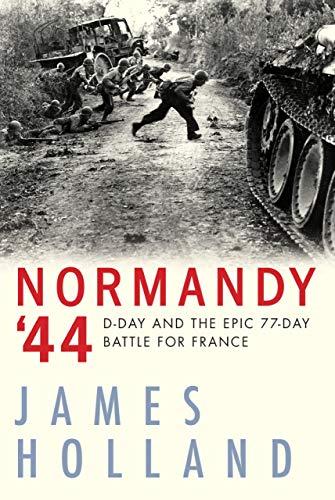
The Steel Crucible: Introduction
The historiography of the Second World War often swings between sweeping grand strategies and intense, muddy micro-narratives. In Normandy ’44, acclaimed British historian James Holland attempts something far more ambitious: a total structural reassessment of the 77-day campaign that decided the fate of the Western Front. Often compared to the authoritative prose of Antony Beevor and the granular combat perspectives of Max Hastings, Holland manages to carve out a distinct space by challenging seventy years of entrenched military assumptions. He doesn’t merely recount the events following June 6, 1944; he fundamentally recontextualizes how the Allied machine ground down the German Wehrmacht through operational patience, industrial supremacy, and overwhelming mechanical force.
Anwar Library Archives: Key Details
| Book Title | Genre | Target Audience | Anwar Library Rating |
|---|---|---|---|
| Normandy ’44 | Non-Fiction / Military History | WWII enthusiasts, strategic analysts, and narrative non-fiction readers | 4.9 / 5.0 |
The Strategic Overview: Quick Verdict & Vibe
Normandy ’44 is a magnificent, paradigm-shifting history that replaces long-held myths of Allied incompetence with a clear-eyed look at logistics, supply chains, and operational realities. It balances immense industrial data with gut-wrenching human stories from both sides of the front lines.
- Pros: Exceptional focus on the often-ignored logistical machinery of war, brilliant use of primary source letters, and a successful re-evaluation of Allied operational capabilities.
- Cons: The sheer volume of divisional designations and tactical supply metrics can occasionally slow down the narrative drive for casual history fans.
The Total War Blueprint: Plot Summary of Normandy ’44 (No Spoilers)
James Holland’s narrative spans from the frantic, high-stakes planning months leading up to D-Day to the brutal, claustrophobic closing of the Falaise Pocket in late August 1944. Unlike traditional histories that focus exclusively on the drama of the initial beach landings, Holland treats June 6 as merely the introductory act of an interconnected, multi-layered war of attrition across the Norman landscape.
The narrative construct is split evenly between the supreme Allied command hubs, the struggling German defensive lines, and the common soldiers caught in the crossfire. Holland meticulously builds the setting, emphasizing the brutal terrain of the French bocage—thick, ancient hedgerows that transformed every square mile of countryside into an insulated, deadly killing ground. He outlines how the Allies had to continuously reinvent their tactical approach on the fly while maintaining an unprecedented supply train across the English Channel via artificial Mulberry harbors.
As the book progresses into the bloody battles for Caen and the desperate maneuvers of Operation Cobra, the narrative tracks the systematic crumbling of the German army. Holland illustrates how the German forces, despite their fearsome reputation and superior individual tank designs, were hollowed out from within by a near-total lack of fuel, air support, and structural mobility, turning the campaign into a harrowing mechanical meat grinder.
Operational Realism vs. Narrative Pacing: Critical Assessment of the Novel
The “Real Talk”: Pacing, Prose, and Impact
James Holland’s writing is remarkably clear and fast-paced, avoiding the dry, textbook-style prose that frequently plagues comprehensive military histories. His central historical thesis is provocative: the traditional view that the Allies won purely through clumsy, brute-force numbers while the Germans possessed far superior tactical skill is a profound misunderstanding of modern warfare. Holland argues that true operational excellence lies in a military’s ability to supply, fuel, and rotate its forces safely—areas where the Allies excelled and the Germans utterly failed.
The pacing of the narrative mimics the campaign itself. The opening sections build tension through bureaucratic and logistical maneuvers, giving way to the frantic chaos of the beach assaults, followed by the slow, grinding misery of the mid-summer deadlock. Holland’s focus on mechanical details—such as vehicle suspension systems, shipping tonnage, and artillery shell production—proves essential to his historical arguments, though it requires a reader who appreciates the operational mechanics underneath the battlefield drama.
The Human Machinery: In-Depth Character Analysis
While Normandy ’44 is a historical record rather than a work of fiction, Holland structures his human accounts with the care of an experienced novelist. Rather than focusing solely on elite generals like Eisenhower, Montgomery, or Rommel, the narrative highlights a diverse cast of real-world figures whose journals and letters ground the strategy in vivid reality. From ordinary infantrymen in the Sherwood Rangers Yeomanry to American paratroopers, German panzer crewmen, and trapped French civilians, every perspective is treated with dignity.
Holland meticulously examines the psychological toll of continuous artillery bombardment and close-quarters combat. By tracking specific historical figures across multiple weeks of the campaign, the book charts the transformation of raw, idealistic recruits into exhausted, hyper-efficient veterans, showcasing the stark human cost of institutional victory.
Atmospheric Chemistry: Vibe Check
Capturing the visceral, historical atmosphere of the Normandy campaign through an operational lens:
- Industrial: A constant, overwhelming emphasis on the weight of steel, ammunition crates, and mechanical supply lines.
- Visceral: Raw descriptions of the mud, dust, heat, and horrific odors that defined the French summer of 1944.
- Vast: A sweeping scope that seamlessly links factory production lines in Detroit and Birmingham directly to the front-line trenches.
- Analytical: A sharp, objective focus on strategic realities that constantly cuts through romantic wartime mythology.
The Logic of Attrition: Themes & Motifs Deep Dive
The dominant theme of Normandy ’44 is the triumph of modern operational logistics over outdated tactical romanticism. Holland uses the contrasting realities of the Allied and German armies to show that modern, total war is won in factories and supply depots long before the infantry fires a shot. The German army’s reliance on horses for transport and their lack of standardized spare parts are exposed as fatal structural flaws, regardless of how formidable their Tiger tanks were in isolated engagements.
Another major theme is the reality of material destruction versus human survival. Holland takes time to analyze the immense trauma inflicted upon the French civilian population, whose cities and towns were entirely leveled by Allied air power and artillery to unseat stubborn German defenses, highlighting the complicated ethical equations of total liberation.
The Historian’s Selection: Target Audience Guide
This book is highly recommended for anyone looking to move beyond basic, entry-level D-Day history into a profound understanding of mid-20th-century warfare. It is an essential read for enthusiasts of operational strategy, logistics, and revisionist history. If you enjoyed the structural depth of Max Hastings’ Overlord or the detailed human perspectives in Rick Atkinson’s Liberation Trilogy, Normandy ’44 deserves a prominent position on your shelf.
If You Loved This Drama: Similar Recommendations
If the operational clarity and deep human focus of Normandy ’44 resonated with you, consider exploring these complementary histories:
- The Guns at Last Light by Rick Atkinson: The definitive, lyrical narrative of the Western Front from D-Day to the fall of Berlin, matching Holland’s balance of grand strategy and individual human perspective.
- Overlord: D-Day and the Battle for Normandy by Max Hastings: A classic military chronicle that provides an excellent companion piece, offering a slightly more critical look at Allied tactical performance.
- The Battle of the West by Antony Beevor: A gritty, profoundly detailed exploration of the campaign that excels at depicting the harrowing reality of front-line combat conditions.
The Global Forum: Cultural Impact and Reader Reactions
Upon publication, Normandy ’44 received widespread acclaim across major historical journals and literary circles for its bold, revisionist approach. On platforms like Goodreads and dedicated history communities, readers frequently praise Holland for shifting the spotlight away from long-standing tactical cliches and placing it firmly on the immense logistical triumphs of the Allies. The book has been highly commended for humanizing the sheer scale of the conflict, securing its position as an essential text for modern educational institutions and serious collectors of World War II history.
About the Author: James Holland
James Holland is an internationally recognized British historian, broadcaster, and author specializing in the history of the Second World War. He has written numerous bestselling histories, including The Battle of Britain and Big Week, and is the co-host of the highly popular military history podcast We Have Ways of Making You Talk. A fellow of the Royal Historical Society, Holland is widely respected for his exhaustive archival research, field interviews, and a unique ability to translate highly technical military data into accessible, gripping narrative history.
Frequently Asked Questions (FAQ)
Q: Does this book cover all the beaches or just the British sectors?
A: Normandy ’44 offers an exceptionally balanced account, providing extensive, detailed coverage of both the American sectors (Omaha, Utah) and the British/Canadian sectors (Gold, Juno, Sword), alongside the subsequent breakout campaigns.
Q: How does this book differ from traditional D-Day histories?
A: Traditional books often stop shortly after June 6. Holland’s work treats D-Day as only the beginning, detailing the entire summer-long war of attrition across Normandy that led directly to the liberation of Paris.
Q: Is this book overly technical for a casual history reader?
A: While it covers operational details like logistics and hardware specifications, Holland’s fluid, narrative style and emphasis on personal diaries keep the material accessible and deeply engaging for readers of all levels.
Where to Buy & Read
Ready to immerse yourself in this unputdownable book? Use the verified, functional search retail links below to find the best deals on physical, digital, or audio editions: